
 Print
Print Word
Word PDF
PDF

|
| Name: _________________________ | Period: ___________________ |
This quiz consists of 5 multiple choice and 5 short answer questions through Chapter 1.
Multiple Choice Questions
1. What affect does a title have on a painting's meaning?
(a) A title can be changed to any words without affecting the viewer.
(b) Words in a title will affect the painting more than the viewer.
(c) A title is not necessary in historical paintings.
(d) Words in a title can change the interpretation of a painting.
2. When do artists begin to use the concept of singular perspective?
(a) In the early Surrealist movement.
(b) In the early Impressionist movement.
(c) In early Abstractionism.
(d) In the early Renaissance.
3. In general, what does seeing do?
(a) Gives you the ability to avoid danger.
(b) Enables you to read.
(c) Enables you to respond to the environment.
(d) Gives you the ability to touch the environment.
4. In general, what are words used to do?
(a) See the environment.
(b) Learn new things.
(c) Explain the environment.
(d) Avoid danger.
5. What invention eventually disproves the idea of center, and single eye?
(a) The computer.
(b) The camera.
(c) The clock.
(d) The microscope.
Short Answer Questions
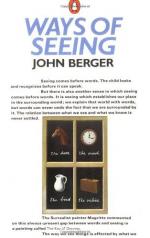
1. What does the author use "The Key of Dreams" as an example of?
2. What do images of the past promote?
3. Which phrase describes Magritte's painting "The Key of Dreams"?
4. Who is Frans Hals?
5. After reproductions are made, an original work of art is unique only in its what?
|
This section contains 266 words (approx. 1 page at 300 words per page) |
|





