
 Print
Print Word
Word PDF
PDF

|
| Name: _________________________ | Period: ___________________ |
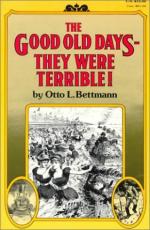
This quiz consists of 5 multiple choice and 5 short answer questions through Chapter 5, Work.
Multiple Choice Questions
1. What major problem did window screening help with in the late 1800s?
(a) Drafts.
(b) Light control.
(c) Insects.
(d) Privacy.
2. What problem did profit motives lead to for street car riders in the late 1800s?
(a) Massive overcrowding.
(b) Lack of upkeep on the lines.
(c) Routes that were not expanded as the city expanded.
(d) Unsafe vehicles.
3. How did Stewart keep as many employees working at one time as possible?
(a) With inadequate bathroom facilities.
(b) He hired men to stand over them.
(c) He hired more than he needed.
(d) He kept his machines in great working order.
4. What was one initial problem with the electric trolley car?
(a) It competed with the horse-drawn streetcars for space.
(b) It didn't hold enough people.
(c) It was way too slow.
(d) It broke down often.
5. According to Bettmann in "Housing," where did poorer residents end up who could not afford tenements?
(a) Homeless shelters.
(b) On the outskirts of the city.
(c) Boarding homes.
(d) Sleeping at railway stations.
Short Answer Questions
1. Why, does Bettmann explain, were pigs tolerated in the cities?
2. What did Richard M. Hunt develop to help with overcrowding and the housing shortage?
3. What work did an ancient stove require on the frontier?
4. What does Bettmann say street car riders in the late 1800s were encouraged to bring along on their ride?
5. Where were the first apartments constructed?
|
This section contains 271 words (approx. 1 page at 300 words per page) |
|





