
 Print
Print Word
Word PDF
PDF

|
| Name: _________________________ | Period: ___________________ |
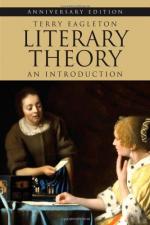
This quiz consists of 5 multiple choice and 5 short answer questions through Chapter 5, Psychoanalysis.
Multiple Choice Questions
1. What is a belief in "ultimate word, presence, essence, truth, or reality"?
(a) Logocentric.
(b) Egocentric.
(c) Phallocentric.
(d) Technocentric.
2. According to Eagleton, eighteenth-century literature embodied more than social values, it also was an instrument for what?
(a) Education and oppression.
(b) Religion and redemption.
(c) Entrenchment and dissemination.
(d) Violence and abdication.
3. Eagleton's goal in "Literary Theory: An Introduction" is to provide a comprehensive account of literary theory for whom?
(a) Those who have specialised knowledge of literary theory.
(b) Those with extensive knowledge of literary theory.
(c) Those who have some knowledge of literary theory.
(d) Those with little knowledge of literary theory.
4. During the Romantic period, how is literature more than "idle escapism"?
(a) It is the rejection of creative values celebrated in English society.
(b) It is the celebration of totalarian values enforced in English society.
(c) It is the acceptance of totalarian values rejected in English society.
(d) It is the affirmation of creative values expunged from English society.
5. According to Viktor Shklovsky, what novel was "the most typical novel in world literature" because it impeded its own story-line so that it never gets off the ground?
(a) "Tristram Shandy."
(b) "Don Quixote."
(c) "Animal Farm."
(d) "History of the Rebellion."
Short Answer Questions
1. How far has the "theoretical revolution" spread according to Eagleton?
2. Why should politics engage with questions of sexual ideology, according to Eagleton?
3. According to Eagleton, one of the gains of structuralism is that it represents a "remorseless _____of literature."
4. According to the Russian critic Roman Jakobson, literature represents "organized ______committed on ordinary _______."
5. Roland Barthes "double" sign is the "grandchild" of what kind of language of the Formalist and Czech structuralists?
|
This section contains 348 words (approx. 2 pages at 300 words per page) |
|





