
 Print
Print Word
Word PDF
PDF

|
| Name: _________________________ | Period: ___________________ |
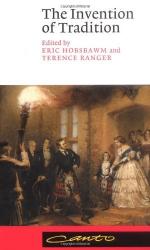
This quiz consists of 5 multiple choice and 5 short answer questions through Chapter 2, The Invention of Tradition, The Highland Tradition of Scotland.
Multiple Choice Questions
1. According to the book, _______ promoted the Highland form of dress as part of their work with the Celtic society.
(a) Military.
(b) Poets.
(c) Lawyers.
(d) Civilians.
2. The Highland garb adopted by the regiments would be used to invent the tradition of ______ dress.
(a) American.
(b) English.
(c) Irish.
(d) Indian.
3. According to the book, the stages of creating the Highland tradition included all of the following elements except _______.
(a) Cultural revolt against England.
(b) Artificial creation of new Highland traditions.
(c) Cultural revolt against Ireland.
(d) The adoption of new traditions by Lowland Scots.
4. One of the costume changes that occurred was the discontinuation of use of the ______.
(a) Short shirt.
(b) Socks.
(c) Kilt.
(d) Long shirt.
5. After the victory at ______ , the English made several moves to destroy the Highland way of life.
(a) Ossian.
(b) Darnaway Forest.
(c) Skye.
(d) Culloden.
Short Answer Questions
1. The author suggests that invented traditions have mostly arisen in the last ______ hundred years.
2. In the middle of the nineteenth century a book called the _______ of the Clans was written that reinforced the myth.
3. The author also makes a distinction between traditions and ______, which have no ritual or symbolic significance.
4. Hobsbawm suggests that the 19th century _____ ideology of social change had to have a new tradition to support it, since it didn't fit in old patterns.
5. Some of the general values that Hobsbawm suggests are used in invented traditions include ______ and school spirit.
|
This section contains 237 words (approx. 1 page at 300 words per page) |
|





