
 Print
Print Word
Word PDF
PDF

|
| Name: _________________________ | Period: ___________________ |
This quiz consists of 5 multiple choice and 5 short answer questions through 19-23.
Multiple Choice Questions
1. What was the name of H. L. Mencken's brother?
(a) Jesse.
(b) Charlie.
(c) Mitch.
(d) Bud.
2. In "The Good Man," what general statement did Mencken make about mankind?
(a) Men are gluttonous, and must continually fight the urge to eat.
(b) Men are not predisposed to appreciate art, and often must be forced.
(c) Man is not perfect, and any strengths are balanced by flaws.
(d) Men are good and kind, and almost always do the right thing.
3. Which man did Mencken dub the "Star-Spangled Man"?
(a) William Jennings Bryan.
(b) Woodrow Wilson.
(c) John Pershing.
(d) George Washington.
4. What did Mencken think about Lincoln's issuing of the Emancipation Proclamation?
(a) Lincoln was tricked into issuing the proclamation by business interests.
(b) Lincoln was doing the bidding of "Black Republicans" by releasing the proclamation.
(c) Lincoln delayed releasing the proclamation until a politically-favorable time.
(d) Lincoln issued the proclamation in a desperate and emotionally-troubled state.
5. In what way did Mencken mock General John Pershing?
(a) Mencken felt the vast amount of medals pinned to Pershing's uniform makes the man look ridiculous.
(b) Mencken brought to light the existence of Pershing's mistress.
(c) Mencken made fun of a recent photograph of Pershing wrapped in an American flag.
(d) Mencken mocked Pershing for a recent bumbling speech.
Short Answer Questions
1. In "Recollections of Notable Cops," why does Mencken find the idea of a police academy remarkable?
2. What is a man's usual response to beauty?
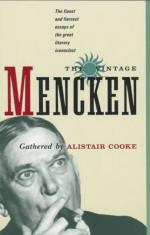
3. Who is the editor of this volume?
4. What was "The Art Eternal" according to Mencken?
5. Which boat captain helped Mencken while in Cuba?
|
This section contains 305 words (approx. 2 pages at 300 words per page) |
|





