
 Print
Print Word
Word PDF
PDF

|
| Name: _________________________ | Period: ___________________ |
This test consists of 5 multiple choice questions, 5 short answer questions, and 10 short essay questions.
Multiple Choice Questions
1. After his work with famine relief efforts, Uwe Brinkmann was dubbed by Germans as a __________.
(a) Conservative.
(b) Liberal.
(c) Communist.
(d) Federalist.
2. German authorities began to argue with the authorities of ___________ over the Lassa virus in Chapter 4.
(a) France.
(b) Italy.
(c) Poland.
(d) England.
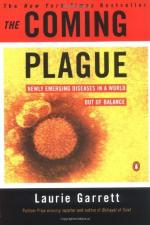
3. Who wrote the Preface to The Coming Plague: Newly Emerging Diseases in a World Out of Balance?
(a) Fred Murphy.
(b) Johnathan Mann.
(c) Uwe Brinkmann.
(d) Laurie Garrett
4. By what decade does the author write that AIDS was an epidemic in the book's Introduction?
(a) 1980s.
(b) 1970's.
(c) 1960's.
(d) 1950's.
5. Soon after the funeral of the first victim in Chapter 5, the mission was filled with the disease and some of the mission nurses were sent to ______________ to recover.
(a) South Sudan.
(b) Zaire.
(c) Tanzania.
(d) Thailand.
Short Answer Questions
1. What did Karl Johnson's team discover to be the culprit of the Bolivian disease in Chapter 1: "Machupo"?
2. What does AIDS stand for?
3. The first polio vaccine was developed by Jonas Salk and first tested in what year?
4. According to the author in Chapter 2: "Health Transition," the study of parasites and tropical disease waned because in post-WWII health care, there was a shift to eradicate __________ from the planet.
5. When Johnson and MacKenzie became ill in Chapter 1: "Machupo," they were saved by a doctor who knew to drastically increase ______________.
Short Essay Questions
1. What is the central focus of The Coming Plague: Newly Emerging Diseases in a World Out of Balance? What is the author's message to the reader as established in the Preface and Introduction?
2. Where was Peter Piot sent to research Ebola? Who worked with the CDC in Atlanta?
3. What impact did the outbreak of Legionnaires' disease have on United States policy? Where did the outbreak occur?
4. What led to the infection of Karl Johnson and Ron MacKenzie? Who saved them and how?
5. How did Del Conn contract disease while studying in Zaire? What difficulties did he encounter in leaving the country?
6. What backlash did the CDC meet after vaccinating against swine flu?
7. What did the Centers for Disease Control do upon learning of the Ebola epidemic?
8. How is the author Laurie Garrett described in the book's introduction and bio? Where did Garrett study? What are common themes in her works?
9. What led to the wane of study on parasitic disease? What discoveries were changing the way scientists viewed infectious viruses?
10. What viruses made impacts in the United States, according to the author in Chapter 6: "American Bicentennial"? When did they occur?
|
This section contains 978 words (approx. 4 pages at 300 words per page) |
|





