
 Print
 Word
 PDF

|
| Name: _________________________ | Period: ___________________ |
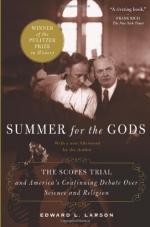
This quiz consists of 5 multiple choice and 5 short answer questions through Part 2, Chapter 4 Choosing Sides.
Multiple Choice Questions
1. Who finds part of a parietal bone and skull pieces long before the trial that become known as the Piltdown skull?
(a) Georges Cuvier.
(b) Charles Darwin.
(c) Chevalier de Lamarck.
(d) Charles Dawson.
2. The combination of what laws result in more students remaining in school beyond the elementary level?
(a) Child labor, labor union.
(b) Compulsory education, apprentice.
(c) Labor union, compulsory education.
(d) Child labor, compulsory education.
3. Bryan hears of the proposal to ban teaching evolution, and as he supports the idea in talks and writing, he does what else?
(a) Addresses the state Senate.
(b) Avoids addressing governmental bodies.
(c) Addresses the state House of Representatives.
(d) Addresses joint sessions of the state's legislature.
4. Larson's introduction serves as a preview of the Scopes trial and issues it raises for whom?
(a) Tennessee society.
(b) American society.
(c) Teachers.
(d) School administrators.
5. Larson presents the leading players, Darrow and Bryan, and provides a sense of what between them?
(a) Tension, professionalism.
(b) Respect, courtesy.
(c) Antagonism, tension.
(d) Respect, professionalism.
Short Answer Questions
1. After defeat of the first bill for a ban on teaching evolution, Bryan argues that who should decide what is taught?
2. When Tennessee's bill passes, the ACLU runs a notice where, seeking a teacher willing to challenge the law?
3. Who spurs the idea that science and religion conflict, and deny a growing consensus among theologians and scientists by the 1900s?
4. What do members of the ACLU view the Tennessee statute as one more attempt to do?
5. Larson shows that how many theories of evolutionary development fit nicely within a Christian explanation of the world?
|
This section contains 290 words (approx. 1 page at 300 words per page) |
|