
 Print
Print Word
Word PDF
PDF

|
| Name: _________________________ | Period: ___________________ |
This test consists of 5 short answer questions, 10 short essay questions, and 1 (of 3) essay topics.
Short Answer Questions
1. When Remnick was in Moscow, who was the last survivor of the Doctors' Plot?
2. How many Polish soldiers were killed the first night in Kalinin?
3. How many years did Bukharian's wife spend in prison or exile?
4. What newspaper did Len Karpinsky work for and later edit?
5. What was the news on August 19, 1991?
Short Essay Questions
1. Why did Sakharov become a dissident?
2. How did the revolution from below begin in July of 1989?
3. What central fact of Gorbachev's early life did he keep to himself until 1990?
4. Why was Genrikh Joffe accused of being a "preacher of bourgeois ideology"?
5. What is the dilemma that Mishal and Flora Litvinov faced with their children?
6. What gnawing uncertainty is the condition of life in the Soviet Union for an empire inhabited by holocaust survivors and the children of survivors?
7. What was Vremya?
8. Why was Andropov important to Gorbachev?
9. How did Stalin gain absolute control over history?
10. What was the homeless situation in Moscow in 1988?
Essay Topics
Write an essay for ONE of the following topics:
Essay Topic 1
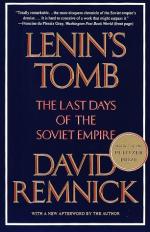
Explain the double meaning of the book's title, Lenin's Tomb.
Essay Topic 2
The poem "Requiem" by Anna Akhmatova became a voice for the organization Memorial. Explain how the poem and the experiences of the poet made this poem a suitable voice and a credo for remembering the victims of the Soviet regime.
Essay Topic 3
In 1989, healers were seen on television shows that were broadcast across the Soviet Union. Explain why the people turned to miracles and the supernatural and why the Party allowed and promoted this indulgence.
|
This section contains 998 words (approx. 4 pages at 300 words per page) |
|





