
 Print
Print Word
Word PDF
PDF

|
| Name: _________________________ | Period: ___________________ |
This test consists of 15 multiple choice questions and 5 short answer questions.
Multiple Choice Questions
1. The patterns and qualities discussed in Book 2, Chapter 2, are part of what?
(a) They are part of the spiritual realm.
(b) They are part of the psyche.
(c) They are part of the atmosphere and part of nothing at the same time.
(d) They are part of the universal consciousness.
2. Athena was the patron goddess of what city?
(a) Athens.
(b) Sparta.
(c) Thrace.
(d) Troy.
3. Book 2, Chapter, 3 is devoted to which group of goddesses?
(a) The maternal goddesses.
(b) The vulnerable goddesses.
(c) The virgin goddesses.
(d) The transformative goddesses.
4. What is the second of two factors that would trouble an Athena woman whose marriage was dissolved?
(a) The fact that she would have to share custody of her children.
(b) The fact that she would lose half of her hard-earned possessions.
(c) The factors that had directly contributed to the dissolution of her marriage.
(d) The fact that everything about her life would be changing.
5. Why did Artemis leave the city she lived in?
(a) She wanted to spend all her time with other women.
(b) She was banished.
(c) She had an argument with the city's patron deity.
(d) She found it too tempting to be around men.
6. Every Greek city-state had a mass what?
(a) Feeding ground.
(b) Hearth.
(c) Food store.
(d) Grave.
7. What sad truth does the author unveil in Book 2, Chapter 1?
(a) Some women lose their babies and never have a special bond with their other children.
(b) When a woman forms this bond with someone else's child, it is hard for her to recover.
(c) Some women never form a special, intimate bond with a child.
(d) Some women give birth and discover they don't have a bond with their own baby.
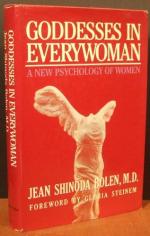
8. Why did the author of Goddesses in Everywoman choose to write this book?
(a) To gain exposure for her own practice.
(b) To promote Jungian psychology.
(c) To help and empower women.
(d) All answers are correct.
9. Who were Athena's usual companions?
(a) Nymphs.
(b) Men or boys.
(c) Animals.
(d) Other goddesses.
10. How many goddesses are written about in each chapter?
(a) One.
(b) Two.
(c) Three.
(d) Four.
11. The author differentiates between what two varieties of archetypes?
(a) Necessary and superfluous.
(b) Dominant and repressed.
(c) Active and inactive.
(d) Feminine and masculine.
12. According to the author, what should be considered for a healthy relationship?
(a) Sexual natures.
(b) Behavior.
(c) Sexual natures and behavior.
(d) Neither.
13. Hestia is described as what?
(a) Outgoing and friendly.
(b) A wallflower.
(c) A jealous lover.
(d) A prude.
14. From what culture did these goddesses originate?
(a) India.
(b) Rome.
(c) Mesopotamia.
(d) Greece.
15. When inhabitants of a city-state left to form a new village, what did they take with them?
(a) A piece of sacred fire.
(b) Their animals.
(c) A piece of their temple.
(d) A piece of stone from their home.
Short Answer Questions
1. What is the author's degree?
2. According to Cook 2, Chapter 2, the goddess archetypes are at work where?
3. The same emotion that is triggered by having a baby can also be triggered by what?
4. What is an Athena woman's most likely downfall?
5. What is the first metaphor used to explain the triggering of archetypes?
|
This section contains 568 words (approx. 2 pages at 300 words per page) |
|





