Dancing in the woods has severe consequences for the town of Salem in Arthur Millers’ play The Crucible as it sparks a witch hunt and the famous witch trials of 1690s. Hysteria and rumors lead a group of young girls to accuse many innocent citizens of witch craft and consorting with the Devil. John Proctor’s mistakes come back to haunt him and his wife as former lover Abgail Adams turns her accusations upon his wife Elizabeth.
The Crucible
by Arthur Miller
Dramatist Arthur Miller was born in New York City in 1915 and became one of America's most prominent playwrights following World War II. The postwar years also saw the...
Read more
Arthur Miller (born 1915), American playwright, novelist, and film writer, is considered one of the major dramatists of 20th-century American theater.Arthur Miller was born on October 17, 1915, in New...
Read more
Arthur Miller was born in Manhattan, the son of a middle-class ladies' coat manufacturer and a schoolteacher mother. He has a brother who became a businessman and a sister who was an actress. Although...
Read more
Arthur Miller is one of the major dramatists of the twentieth century. He has earned this reputation during a more than sixty-year career in which he wrote his first plays as an undergraduate at the U...
Read more
Biography EssayArthur Miller was born in Manhattan, the son of a middle-class ladies' coat manufacturer and a schoolteacher mother. He has a brother who became a businessman and a sister who was an ac...
Read more
Reverend John Hale is an educated but naive witch hunter, brought into Salem by Reverend Parris to examine his daughter Betty and give his expert opinion on her condition. Arthur Miller describes Hal...
Read more
Any one person can have the physical, mental, or spiritual authority over another person and can use it in many different ways. This could be to take control of that person's life or this authority ca...
Read more
Hale went to Salem with his authority in witchcraft and his strong belief in the authority of the church hoping to rid the community of witches. The invitation that Hale got was his ticket to use fina...
Read more
`The Crucible' by Arthur Miller is an extremely powerful and thought provoking play. Internal conflict within the main character, John Proctor, has a major influence over events in the play. This in...
Read more
There are several aspects of the human character that often prove too powerful for people to control. Arthur Miller, the famed satirical author of, The Crucible, portrays many of the characters in th...
Read more
The role of pride stood out tremendously in Act 4. There were many characters who demonstrated pride in the way of normal behavior. There were also characters that seemed to gain stature because of ...
Read more
Explore the characters of John and Elizabeth Proctor and their relationship. What does studying these characters tell us about the society of seventeenth century Salem and human nature today"
The Cr...
Read more
Act Four, the final act of Arthur Miller's "The Crucible", plays a particularly important part in the drama. This essay will examine its dramatic importance, highlighting the use of dramatic devices,...
Read more
According to Britannica's online dictionary, the word lie when used as a verb means to make an untrue statement with intent to deceive. The art of lying was perfected in Salem's society during a v...
Read more
When one chooses to direct a movie based on a play or text, one must make imperative decisions on how to establish mood, setting, and imagery. To establish this they may add new scenes that weren't i...
Read more
According to Britannica's online dictionary, the word lie when used as a verb means to make an untrue statement with intent to deceive. The art of lying was perfected in Salem's society during a vola...
Read more
The Crucible explores how authority and individuals interact, in particular, when the authority is corrupt and the individuals are of strong conscience. It presents various ideas about the conflict t...
Read more
Madness: The Devil's Agent in Salem
by Colin Swanson
Euripides, the renowned ancient Greek playwright, put forth the thought, "the devil when he purports any evil against man, first perverts his min...
Read more
The John Proctor Analysis
Heroic figures shine out during the darkest of times. John Proctor, the main character in Arthur Miller's play The Crucible, shows heroic attributes while the city of Sale...
Read more
A Moral Dilemma
In Arthur Miller's play The Crucible, the Reverend Hale tries to persuade John Proctor to give a false confession and save his life while his wife, Elizabeth Proc...
Read more
The Crucible
In the story The Crucible, the word crucible is never mentioned. Even though crucible isn't mentioned, it pertains to the story in many ways. Crucible means a severe test of ...
Read more
The Crucible by Arthur Miller is set in Salem, Massachusetts at the time of the 1692 Witch trails. It shows a struggle between good and evil, God and the Devil and the freedom of opinion or lack of i...
Read more
The Crucible, by Arthur Miller, has many key themes, but the theme that had the most significant effect on the reader was courage. Many characters show courage throughout the play. Reverend H...
Read more
Benito Mussolini was born on the 29th of July, 1883, at Dova di Predappio, near Forli, Italy. Benito was undisciplined as a child; however, he demonstrated sharp wit and intelligence, as well as a po...
Read more
The Crucible by Arthur Miller shows both static and dynamic characters. John Proctor is a dynamic character, this is shown through events, motivating forces, and circumstances.
John Proctor is a cha...
Read more
Parris Proctor is suspecting that his daughter, slave Tituba, friend Ruth and his niece Abigail have been involved in witchcraft. They were all puritans and witchcraft was against the beliefs of t...
Read more
The Crucible
1. The golden candlesticks represent the greedy attitude of Reverend Samuel Parris. He had been preaching about getting the candlesticks and escalates it to getting the deed for the chur...
Read more
The Crucible
Character Studies:
John Proctor
The central character if the play, a farmer in his middle thirties. Singled out by Miller because of the vast differences he has when compared to all ...
Read more
“The Crucible” is a play based on real life events that happened in Salem, Massachusetts in 1692. Arthur Miller had been fascinated by what he calls the "inexplicable darkness" surrounding ...
Read more
Parris has a selfish agenda, which results in being evil. Parris lies so that he looks good and tries to downplay how bad the situation is. He does this because he wants his image to remain good in ...
Read more
Arthur Miller's "The Crucible" is about the Salem witch-trials in Boston. It deals sepcifically in the mass hysteria that witch-craft brought upon people and the people's consequential loss of reason...
Read more
A sociopath is affected with a personality disorder marked by an antisocial behavior. There are many people who have mental problems that make them operate differently. In The Crucible by Arthur Mil...
Read more
In The Crucible by Arthur Miller, many actions take place taken on by feelings. A couple of small ideas cause chaos and many things go down because of it. The characters in The Crucible have let fear...
Read more
"For the people." This statement can readily be applied to Reverend Samuel Parris. Rev. Parris was a good man who was trying to find his place in Salem as a good minister who wanted the people of Sale...
Read more
The "witch hunt? (I. 7) of the 1950's lead Arthur Miller to view the McCarthyism similar to the Salem witch trial and this is clearly seen in his play, The Crucible. Miller uses only the broad simila...
Read more
Arthur Miller's play The Crucible is about the persecution of innocent people who were falsely accuses of being witches in Salem Massachusetts, in 1692. Many people in the village were killed after a ...
Read more
There are many different themes in Arthur Miller's, The Crucible. One very important theme that is evident throughout the entire novel is revenge, or punishment in return for. Three characters that w...
Read more
In Arthur Miller's play The Crucible, John Proctor embodies numerous themes. The play commences at the house of Reverend Parris. The previous night, Parris had caught his young daughter Betty, his ...
Read more
Throughout history, the alliance of fear, ignorance and the unknown have set out to exploit mankind's weaknesses and to decimate any shred of common sense and reason that an individual may hold. The e...
Read more
One of the themes in Arthur Miller's, The Crucible, involves the principle of dying with nobility rather than compromising one's morals for life. John Proctor was the character Miller chose to convey...
Read more
People in this world do a lot of things based on fear. "Nothing is so much to be feared as fear itself", is a great quote explaining why people act on fear. Fear is something to be feared because, a l...
Read more
In the time- honored classic, The Crucible, by Arthur Miller, is a play about sin, paranoia, hysteria, and religious intolerance. The main character, hardworking farmer John Proctor, is a tragic her...
Read more
What exactly is an ethical society? According to philosophers an ethical society one where each person has the right to be free, think for themselves, and to be free to practice their creeds. To a bas...
Read more
Are you willing to give you life rather than confess to something you didn't do? A lot of people in Arthur Millers book The Crucible died for refusing to confess to something that they didn't do. The ...
Read more
I feel that in Act Four one of the prevailing themes is brought to life not only by Danforth but also by John Proctor, this theme is the task to protect one's name. Miller uses Danforth and Proctor t...
Read more
Of all the characters in Arthur Miller's play The Crucible, Deputy Governor Danforth is the least admirable character. Danforth thinks he's superior to others, he is unmerciful, and he is inconsid...
Read more
There are numerous people who could be held responsible for the outcome and happenings of the Salem witchcraft trials in the play The Crucible by Arthur Miller. This was not a typical trial. Unlike ...
Read more
In the play "The Crucible" Mary Warren and Abigail Williams play a crucial role. Abigail Williams is Reverend Parris' niece. She used to work for the Proctors but committed lechery with John Proctor...
Read more
What does the word crucible mean? According to the Webster's English dictionary, it means "a severe test" which can be mentally or physically challenging. In Arthur Miller's drama The Crucible, Miller...
Read more
Mind controlling sequences lead the conscience to decide something that is wrong in God's eyes but may bring forth a lie to control the sake of your life. Believing in what you think is true may be ...
Read more
The Crucible by Arthur Miller and The Life You Save May Be Your Own by Flannery O'Connor, are two very extraordinary, but yet different pieces of writings. In this particular essay, I want to analyze ...
Read more
Well, lets see here. Abigail Williams first of all, is not a very well liked person in the community. That in turn doesn't give her a very good chance in coming into this court with a chance of bein...
Read more
The renaissance author, Sir Francis Bacon said that, "In taking revenge, a man is but even with his enemy; but in passing it over, he is superior." This is suitable to say about Hester Pryne and Abiga...
Read more
The award winning, renowned author, Frank Herbert, wrote a fantastic passage about fear in his celebrated novel, entitled, Dune, it reads, "I must not fear. Fear is the little-death that brings total...
Read more
As people grow and they mature, they are very apt to change. In The Crucible, by Arthur Miller, many of the main characters experienced a shift of interests. One of the main cha...
Read more
The sixth commandment states, "Thou shall not commit adultery." This is something that both John Proctor from "The Crucible" and Arthur Dimmesdale from The Scarlet Letter committed. John Proctor's pa...
Read more
In the crucible, there are some dramatic and verbal ironies. The dramatic and verbal irony arises when things are not what they seem. Dramatic irony is when there is contradiction between what a chara...
Read more
The Crucible, by Arthur Miller, is an extremely powerful and thought provoking play. Internal conflict within the main character, John Proctor, has a major influence over the events in the play...
Read more
Although Abigail always tries to protect her purity, her underneath motive is to blame everyone else to make herself an innocent girl. For example, when being asked about the witchcraft by Reverend ...
Read more
The American writer Arthur Miller was born in 1915 in New York, where he grew up and had a happy childhood. In 1938 he graduated from the University of Michigan and began to write his first play...
Read more
Two definitions of the word "crucible" can apply to the title of the play The Crucible, "a container for melting or purifying metals" and "a severe test." The village of Salem was a strict puritan com...
Read more
Looks can indeed be deceiving and nobody illustrates this fact more than Abigail Williams from Arthur Miller's brilliant play "The Crucible." Thought of as nothing more than a harmless teenager Abiga...
Read more
The Puritans are a group of strong-willed, militant people, shaped by English experience and a complete dedication to religion. The Puritan society has molded itself and created a government based ...
Read more
The main problem with the witch-hunt is that people using persecution to benefit themselves corrupted the accusations. When people use a witch-hunt for personal gain the witch-hunt accomplishes exa...
Read more
While I can not agree nor disagree with this statement because I have not read multiple writings by this author, I do agree with Kerr when if comes to describing what Miller has to say about the Sale...
Read more
In Arthur Millers play The Crucible, it is a known fact that Miller changed certain aspects of the play in order to make the events seem more exciting as well as make it seem more realistic to the pe...
Read more
In act one of The Crucible, chaos is the dominant atmosphere. The scenes are full of tension and the general feeling that it would take very little to over stress these very tense people. Mrs. Ann P...
Read more
People are often forced to makeup population-impacted lies which influence cultural beliefs in order to protect themselves from punishment from the public. During the 1700's, Salem has been known hav...
Read more
In the play The Crucible, written by Arthur Miller, Abigail Williams is a very manipulative, seductive, and dishonest person. She is constantly caught up in a lie or is in the presence of trying to...
Read more
During the spring and summer of 1942, the United States Government carried out, in remarkably short time and without serious incident, one of the largest controlled migrations in history. This was the...
Read more
There was a crime committed down the street and a few kids say they saw you doing the crime. You have nothing to prove to them that you didn't. You were held responsible for it. What would your reac...
Read more
The most flawed character in The Crucible was Abigail Williams. I find her as the most flawed for more than one reason. Although she never expected her plans to go as far as they did she still dese...
Read more
There are many different conflicts in the play. However, Abigail Williams creates the key conflict throughout the play as well as stirring up some minor conflicts.
In the beginning there is only one ...
Read more
Reverend John Hale is a minister from Beverly who is called to Salem by Rverend Parris to investigate the situation. He is about forty years old and has a strong belief in the authority of the chur...
Read more
"The Crucible" by Arthur Miller is a play that describes the witchcraft trials in Salem in 1692. The background of this play is the Mc.Carthy "witch-hunt" and the activities of the "house of un-Amer...
Read more
It is interesting to see how intentions can change through sex and greed. Someone of great morals and love might cheat on their life long mate just for pure pleasure. And maybe through jealousy and ...
Read more
Everyday we wake up to a world that is said to be unfair or cruel. We awaken to the freedoms and virtues of a world of ignorance. In my beliefs I can strongly assume that based on the fact that we do ...
Read more
The film The Crucible, based upon Arthur Millar's thought-provoking play, captures the audiences attention as they are lead from misguided but seemingly harmless beginnings through to a mass hysteria ...
Read more
While justice is meant to be administered with upmost fairness and equality Aurther Millers play The Crucible demonstrates that this does not always prevail, and in many circumstances the forces of in...
Read more
Marriages in the late 1600's were all but romantic although the husband and wife loved each other; it took awhile for the bond to really develop into love. John and Elizabeth Proctor's marriage is a p...
Read more
Identify at least 3 core aspects of the Human Condition, explored in The Shawshank Redemption. These may be taken from the list on your sheet or your own devising. It is important that in writing abou...
Read more
Elizabeth Proctor, wife of John Proctor in The Crucible, has many similarities with Abigail Williams, niece of Reverend Parris, yet they contrast also. Throughout the play, both characters grow and...
Read more
During the string of events in Salem, MA, John Proctor undergoes a crucible bigger than any other character in The Crucible. Not only does he have to decide with whom to ally himself with during the h...
Read more
The term changing perspective is ever-present in our society. From the guy down the street who decided he did want to put in that pool after all, to the girl who finally reconciled with her brother af...
Read more
During the year of 1692, a great cataclysm agglomerated in the small Massachusetts village of Salem. A town that once displayed a Puritan hardworking predilection, a common purpose to achieve self ind...
Read more
Contrary to what people might believe, the court systems from the 1950's and the 1690's are similar in many ways. In Salem, Massachusetts in the 1690's, people were being accused of having dealings ...
Read more
Hysteria in The Crucible and Three Sovereigns for Sarah In the play, The Crucible, and the screenplay, Three Sovereigns for Sarah, hysteria plays a key role in contributing to the murders of innocent...
Read more
Before we can begin to think about to what extent John Proctor was a tragic hero we must define the term "tragic hero" actually means.
A tragic hero has many distinctive characteristics such as nob...
Read more
In the play The Crucible written by Arthur Miller, the reader can clearly see the true meaning of the word "crucible." Some of the charactors experience the meaning of the way that Miller has used th...
Read more
An evil person is not one who conceives corrupt thoughts and pursues them, rather one who is overwhelmingly concerned with his/her own personal welfare. Being concerned with one's own well being...
Read more
"As steel sharpens steel so one man sharpens another." In The Crucible, Mary Warren and Abigail Williams sharpen each other; even though they have similarities they also have great differences. Both M...
Read more
The ironic and cynical tones in Arthur Miller's The Crucible of the witch trials further his pained outlook on the lack of justice in a condemning society. All hope is taken from any innocent once th...
Read more
Did John Proctor make the right decision at the end of the play? A reader's toughest question after they read Arthur Miller's The Crucible. Arthur Miller was a very creative writer, when he compare...
Read more
When a tragedy happens in a community, there is a sense of responsibility felt by all that were connected. Even though you can't help but feel accountable if you were a part of it, its human instinc...
Read more
In the Crucible, Arthur Miller demonstrates many different types of people and attitudes towards witchcraft in the town of Salem. The main character, "John Proctor" is a good honest and very out spok...
Read more
Marry Warren plays a very important role in The Crucible in the development of the plot. Mary Warren is a character of weak determination who allows herself to be bullied constantly. She is not an ...
Read more
In The Crucible, by Arthur Miller, the characters portray many flaws such as selfishness, fear, and jealousy that are present in many individuals today. These flaws are often the cause of many proble...
Read more
In the novel, The Crucible by Arthur Miller shows very diverse and dynamic characters. One such character is Elizabeth Proctor. She is a petite woman with dark brown hair and rarely smiles because o...
Read more
The story "The Crucible" takes place is the 1600's and is about the Salem witch trials. Abigail a young woman niece of the towns reverend has every body convinced that the devil is loose in Salem. ...
Read more
In the play, The Crucible by Arthur Miller, there are many important characters. However, two of the characters in this novel stand out the most. These characters are Elizabeth Goody Proctor and Abig...
Read more
Arthur Miller, an established playwright known for creating works of prolific social commentary, wrote The Crucible in 1952. The play fictionally portrays the 1692 Salem witch trials, in which dozens...
Read more
Before analyzing this quote by Reverend Paris, several facts should be noted about the Puritan community of Salem. Like their fellow Puritans of other communities the Salem Puritans were an extremely ...
Read more
The power of falsehood in the crucible is greatly shown throughout the book in three examples. The fact that Abigail wanted john proctor and the things she lied about to try and get him. Also, how eve...
Read more
Artists use brushes of different textures and paints of diverse shades to create their masterpieces. Similarly, playwrights use different tools to make a performance worth viewing. In Arthur Miller's...
Read more
In Anthony Storr's Under the Banner of Heaven, he states that what one person "proclaims as `the truth' is incompatible with the beliefs of other people." In The Crucible, the main idea is that peop...
Read more
Ever wonder what went on in the days when Puritans ruled most of what is now the United States? During that time there was a man, actually, the man with the plan and his name was Jonathan Edwards. He ...
Read more
In the play, The Crucible, the people were in search of a person accused of witchery. Many died because of the person that was indeed attempting witchery, but she was never captured. Many cases hav...
Read more
In The Crucible, many symbols are used whether it is through characters or objects. One of the symbols that are mentioned in the play is cows that roam Salem. The cows that roam Salem's streets repr...
Read more
No way is John Proctor a Christ-like figure. One big reason why he is not a Christ-like figure is his adulterous ways. Another reason why he is not a Christ-like figure is that he committed adultery...
Read more
John Proctor is not appropriately named in The Crucible. The word "proctor" means good order and John Proctor is the total opposite. Arthur Miller tells the audience that Proctor has to deal with ma...
Read more
Arthur Miller's The Crucible was successful in fulfilling his intentions for the piece of writing. The reason why Miller wanted to write The Crucible was so that he could share his point of view on t...
Read more
Oscar Mandel, analyzing a quote by the great Aristotle, said, "A work of art is tragic if it substantiates the following situation: A protagonist who commands our earnest good will is impelled in a gi...
Read more
`The Crucible' is a play written by Arthur Miller, first produced in 1953, about the Salem Witch trials of 1692. The events in `The Crucible' parallel those that occurred in the 1950's, when Senator M...
Read more
When learning about Arthur Miller, four very important criteria appeared to judge if a character is tragic or pathetic. In The Crucible, John Proctor is a tragic figure as defined by the criteria desc...
Read more
In The Crucible, witch trials are the center of attention. Dramatic accusations and confessions flood the story even beyond the courtroom. The entire courtroom depends on accusations, which is also th...
Read more
In the 1950's Arthur Miller wrote `The Crucible', a play that was to become an enormous National Theatre Production. This play, still staged today, is a fictional retelling of events in American Histo...
Read more
In American Literature we have two recurring themes, religious fanaticism and guilt. These American themes are important to us because we have based our culture on the puritans, and early immigrants....
Read more
In Salem, Massachusetts, John Proctor undergoes as one of the few in the witch trials. His crucible, or test, is but of what more powerful than any other that one is to go through. He must decide w...
Read more
The Crucible, by Arthur Miller is based on the tragic Salem Witch Trials of 1692. This play takes a look into the lives and emotions of many characters that lived in Salem, Massachusetts during these...
Read more
The Crucible
In The Crucible, Arthur Miller details how a lack of religious tolerance can be destructive to human rights and ultimately to society itself. He does this through various situations in ...
Read more
In our lives, many mistakes are made because of wrong decisions. It is impossible to live a faultless life; guilt will always grow strong from our regrets. These regrets are from the sins that have ...
Read more
The Crucible, a historic play by Arthur Miller, goes into depth about the lives of certain characters who are involved in the Salem Witch Trial. Throughout this play, he uses suspense to capture the ...
Read more
Arthur Miller's, "The Crucible", is set during the Salem witch trials in 1692.
"The Crucible", is considered to be a great American classic brutal portrayal of the witch trials. The play is drenche...
Read more
The play opens in the woods outside of Salem, Massachusetts, where a group of girls lead by Abigail are dancing. Tituba, the black slave, murmurs something over a kettle and then gives the blood insi...
Read more
In the play the Crucible written by Arthur Miller, John Proctor, a strong independent man, Elizabeth Proctor, a strong willed and good person who is married to John Proctor and Reverend John Hale,...
Read more
In the play The Crucible, Arthur Miller shows how a lack of tolerance, based in religion, can be troublesome for people and ultimately to society itself. Personally, I thought that Miller did a great ...
Read more
John Proctor was a big and strong man. He was a man that everyone in the town looked up to. He was a loving husband, a hard working farmer, a proud father, and most important a faithful Christian. In ...
Read more
As the town of Salem, Massachusetts cried witchcraft, one girl led the children's crusade against the accused. Succumbing to fits of hysteria and screaming names, the character of Abigail Williams is...
Read more
Miller suggests that a person who is guilt free has ultimate freedom. In The Crucible, when John Proctor went to the gallows he had not attained his ultimate freedom. Miller accurately entitled his dr...
Read more
The Bravest Character of "The Crucible"
What can make a character of a play the bravest person? In Arthur Miller's play,
"The Crucible", John Procter's actions put him in the situation of be...
Read more
"I cannot mount the gibbet like a saint. It is fraud. I'm not the man" (Act 4, pg.109) Proctor, an honest and admirable man, plays one of the main parts in the Crucible, a play based on jealousy, sup...
Read more
In Arthur Miller's novel "The Crucible," abuse of power and use of manipulation is rampant. This is especially true of Abigail, the teenage niece of Reverend Parris, who lives in his house along with ...
Read more
In Salem, everything is based on whether you're with God or the Devil. Anyone whose life doesn't conform to the established moral laws was considered a threat to society and disobeying the rule of Go...
Read more
English Review: The Crucible
Millers play The Crucible is a valuable text when studying the issue of conformity and the individual, which are themes that run through the play.
The book The ...
Read more
In "The Crucible", written by Arthur Miller, a major character by the name of Abigail Williams is the least intricate to figure out. By observing Abigail's influence on the town of Salem...
Read more
Conflict is the corner stone around which any text is moulded, as every narrative involves a complication for interest. Two texts that represent conflict are Arthur Miller's play, The Crucible and Joh...
Read more
In many cases, a single group of people can cause an outrageous catastrophe among a typical, normal society. In one incident, The Crucible, by Arthur Miller depicts the immense, irreversible ...
Read more
"If you hate someone, you hate something in him that is part of yourself. What isn't part of ourselves doesn't disturb us." This citation by Herman Hesse rightly describes the situation in Salem vil...
Read more
From June through September of 1692, nineteen men and women, were convicted of witch craft and were sentence to death. These events took place in a small village name Salem, and it's described in Art...
Read more
In The Crucible by Arthur Miller, John Proctor, a local farmer who lives just outside town, is one of the leading roles. John was determined, sincere and full of integrity. As the protagonist of the...
Read more
Compare Contrast Hale/ Danforth
In The Crucible, by Arthur Miller, Reverend Hale and Governor Danforth play the two leading sources of authority in the Salem Witch Trials. At the time of the trials i...
Read more
Tragedy of Proctor
John Proctor is not your everyday puritan farmer of the 1690's. He has a deep secret he would do almost anything to keep hidden. Not only does he live with the shame of his lust, ...
Read more
John Hale in Arthur Millers "The Crucible" plays a key role in representing a the real sense of justice in the play. He first enters the play when he is called upon by Reverend Paris to examine the ...
Read more
Where can one find a town in which you can be tried and hanged out of mere suspicion? Salem Massachusetts! In his book, The Crucible, Arthur Miller describes the events that lead up to the hanging of ...
Read more
Arthur Miller begins his article with background of the years in which he wrote the story; years full of Communism, fear spread by Senator Joseph McCarthy, and Fascism. He wrote his play The Crucible ...
Read more
The Crucible
The movie, The Crucible, was a very interestingly strange movie. I believe it depicted the Salem witchcraft trials extremely well. I learned so much more than I was expecting to from...
Read more
In comparison to the play, the tone of The Crucible, changes in the adaptation of the movie. In dramas, the stage scene in written to be read, and as the writing is revealed an idea is unraveled, howe...
Read more
Personal motives can lead to either good or evil, depending upon the person and their motives. In The Crucible, the small town of Salem is caught up in the mass hysteria of witch trials. Abigail's, P...
Read more
Crucible Analytical Essay
The philosophical view of the puritan pilgrims affects their actions in the Crucible because their main belief was to purify their surroundings and the church. If they thoug...
Read more
The Natural Effects of Self-forgiveness
We often think of forgiveness as something that someone who has done us wrong must ask of us. It is a gift that you give to yourself, not to others. Forgivene...
Read more
Societal constructions most often times serve as great frameworks of control. These constructions can also become lethal through use of legitimate violence to enforce notions of ethics and morality....
Read more
With the mistakes of humanity comes both sin and guilt. The Crucible written by Arthur Miller shows the true chaos and panic of the Salem Witch Trials. John Proctor believes his affair with Abigail ...
Read more
Throughout the play script and film The Crucible composed by Arthur Miller, many themes have been explored. The predominant one being hysteria and the role it played in tearing apart the town of Salem...
Read more
Cruelness' Effects on a Person
The cruel actions in the crucible were justifiable in the name of righteousness, so the reputations and names of the characters, and the town of Salem were not looked d...
Read more
Arthur Miller wrote `The Crucible' in the early 1950s, drawing on research he had done as an undergraduate, he wrote the play during the ascent of Joseph McCarthy and his strong anti-communist polic...
Read more
Many characters display acts of courage in Arthur Miller's play "The Crucible." However, one character in particular has more courage than the others. That character is John Proctor. He speaks ou...
Read more
Arthur Miller's The Crucible consists of many characters, some evil, some good, and some characters that are only viewed as good people. For example, a faithful Christian character like Elizabeth does...
Read more
"The Crucible" Essay
A crucible is defined as "a vessel made of a refractory substance such as graphite or porcelain, used for melting and calcining materials at high temperatures" or "a severe test...
Read more
John Proctor is the tragic hero as he has many positive traits about him, such as his noble characteristics and his honourable and righteous qualities. He however also had a darker side to his otherwi...
Read more
Dressed in black with a white collared neck, both Reverend Hale and Reverend Parris from the play The Crucible have striking similarities. Being both highly intelligent men of God, these ordain...
Read more
"I like flawed characters because somewhere in them I see more of the truth." A flawed character can be one of many kinds of people in a novel, including a tragic hero or a desperate persona. The Cruc...
Read more
Abigail Williams summarizes this whole play, which makes this storyline so interesting compared to the other characters in the play. She discovers ways and schemes to conceal her bad behavior because ...
Read more
In Arthur Miller's play, The Crucible, his portrayal of religion and sin create dramatic irony. In the story, the words and actions of the characters take on a different meaning for the audience than ...
Read more
Destruction of a world by one lie
The Crucible, a play by Arthur Miller, exposes how one misconception, one lie could lead to a disastrous situation. It is a play about the Salem Witch trials, writt...
Read more
The Crucible
The Crucible is a powerful and disturbing drama based on a true event from American history: The Salem Witch Trials of 1692. It shows how weak the human beings really are, and how greed...
Read more
In "The Crucible", Arthur Miller asserts that good and evil are relative. In other words, concluding whether something or someone is good or evil depends upon certain circumstances. From this he conce...
Read more
Many theories exist to explain the occurrence in Salem Village during the years 1691 and 1692. They range from simple adolescent misbehavior to a mass stress vent, from foolish and panicking ministers...
Read more
One of the ways that Miller reveals his views of the Puritans is through the character of Reverend Parris. Parris is a walking contradiction, a man of the church who suffers from irrational paranoia a...
Read more
Destroyed and defeated are two very powerful words. However, not all that is destroyed is defeated. The quote "A man may be destroyed but not defeated," by Ernest Hemingway implies that a man can be d...
Read more
Essay
A tragic hero often times pertains to the nature or character of a person. Their attributes may include having a tragic flaw, falling from a great height in society and most importantly mee...
Read more
The play "The Crucible" by Arthur Miller portrays a community that is based on paranoid accusations of witchcraft ending in mass hysteria. The accusations led to dozens of alleged witches being prose...
Read more
In Arthur Miller's "The Crucible", the character Abigail is used as a tool to convey to the audience the hypocrisy and irony of their society. The time of Salem is used as a metaphor for the society t...
Read more
English Conflict Essay
The Crucible features many different types of conflict. The Webster's dictionary defines conflict as to clash or to be antagonistic, incompatible or contradictory. Throughout a...
Read more
The film, "The Crucible," directed by Nicholas Hytner conveys ideas about authority through two main characters, Hale and Danforth. Danforth is represented as authority of justice whereas Hale is pr...
Read more
There are many different characteristics that when molded together form an American Tragic Hero. Some of these characteristics may be minuscule, however they are crucial when applied to an American T...
Read more
Even amateurs in the psychology of human relationships still have an idea of why relationships work, what fuels them and why they end. Human relationships are vital to everyday life. Providing a defin...
Read more
In 1964 when the crucible was set there was a set attitude towards marriage. The social and historical context of the play in the relation to the affair is the fact that they don't act like lovers whe...
Read more
Film Analysis paper
The Crucible
For my film analysis, I decided on the movie The Crucible. The movie takes place during the Salem witch trails and shows a mostly accurate representation of what h...
Read more
Arthur Miller's, The Crucible, conveys many important values, central to the play through the use of conflicts between individuals and their society. Miller explores the importance of standing up for ...
Read more
In the film "the crucible" directed by Nicholas Hynter is based on the play by Arthur Miller set in Salem 1692. It is a relentlessly suspenseful drama of collective evil and personal conscience. At i...
Read more
Knowing Too Much of Anything Can be a Weakness
Both The Scarlet Letter, by Nathaniel Hawthorne, and The Crucible, by Arthur Miller, share a universal theme. Knowing too much of anything can be a we...
Read more
John Proctor's Decision of Death
By Daniel Waters
In Salem, to John Proctor, the reputations of people were more important than life itself. John Proctor was well-known and respected in th...
Read more
Arthur Miller's, The Crucible, was written during the 1950's at the height of the Red Scare, and the play describes the Salem Witch Trials of 1692. The Crucible explores the dangers of theocracy and ...
Read more
The Crucible Book Notes is a free study guide on The Crucible by Arthur Miller. Browse the summary below:
Author Biography / Context of the Work
One-Page Plot Summary
Charac...
Read more




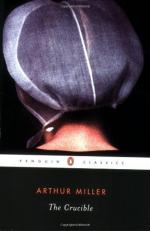
 The Crucible
 Arthur Miller
 Arthur Miller

 The Crucible