
 Print
Print Word
Word PDF
PDF

|
| Name: _________________________ | Period: ___________________ |
This test consists of 5 multiple choice questions, 5 short answer questions, and 10 short essay questions.
Multiple Choice Questions
1. What were innovative characteristics of Rudolphe Töpffer's work?
(a) All of the above
(b) Cartooning
(c) Interdependent combination of words and pictures
(d) Panel borders
2. Most Japanese comics first appear published in __________________.
(a) manga magazines
(b) enormous anthology titles
(c) thin publications
(d) parts
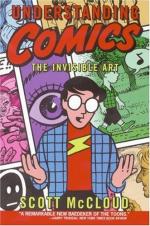
3. Who is the author of the book?
(a) Rudolphe Töpffer
(b) Stan Lee
(c) Will Eisner
(d) Scott McCloud
4. What new law was created to protect Töpffer's new art form following the successful publication of "A Harlot's Progress" and its sequel?
(a) Income tax
(b) Restraining order
(c) Minimum wage
(d) Copyright
5. Pictures are ______ information. Writing is _______ information.
(a) perceived; received
(b) received; received
(c) perceived; perceived
(d) received; perceived
Short Answer Questions
1. Using the pictorial vocabulary pyramid, Mary Fleener's style is NOT typically comprised of ________.
2. What is the phenomenon of observing the parts but perceiving the whole?
3. When McCloud refers to the word icon, to what is he referring?
4. The author describes comics as a ______, or a medium which "can hold any number of ideas and images."
5. What symbol does the author use to demonstrate the universality of cartoon imagery?
Short Essay Questions
1. Is a single image equivalent to a single instant in time?
2. How do Japanese comics physically differ from Western comics?
3. Describe what cartooning style is.
4. What is McCloud's notion of the Picture Plane?
5. Why does the author introduce the Margritte painting, "The Treachery of Images"?
6. For what do Japanese mainstream comics use aspect-to-aspect transitions?
7. Describe the author's first impressions of comics as a child.
8. What are different ways to portray motion within panels?
9. Does McCloud think single panels should be considered comic art?
10. How are faces and figures typically drawn in comics? What about backgrounds and landscapes?
|
This section contains 845 words (approx. 3 pages at 300 words per page) |
|





