
 Print
Print Word
Word PDF
PDF

|
| Name: _________________________ | Period: ___________________ |
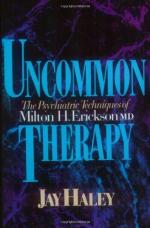
This quiz consists of 5 multiple choice and 5 short answer questions through Chapter 5, Marriage and Its Consequences.
Multiple Choice Questions
1. Which heading in Chapter 1 shows how Erickson gets the husband to enter therapy just to straighten out the therapist?
(a) "Avoiding Self-Exploration".
(b) "Emphasizing the Positive".
(c) "Encouraging Resistance".
(d) "Encouraging a Response by Frustrating It".
2. Haley explains that there are times when _____ rather than the family of origin are the real source of the problem.
(a) Teachers.
(b) Uncles.
(c) Aunts.
(d) Peers.
3. One case of Chapter 4 includes a man named Harold who asserts that he is homosexual and hates women. He is also what?
(a) Married with children.
(b) Deaf and mute.
(c) Financially poor and an idiot.
(d) Wealthy and attractive.
4. In most of the examples referred to in Chapter 3, success in dating leads not only into marriage, but also into ____.
(a) Life.
(b) Parenting.
(c) Career.
(d) Divorce.
5. Erickson typically conducts therapy with the goal of keeping a couple together except for two types of case: one, if the couple feels the marriage was a mistake, and second, in the event that the marriage does what?
(a) Leads to intense sexual insecurities.
(b) Puts either or both members of it into danger.
(c) Makes either of the members unhappy.
(d) Leads to problems with children.
Short Answer Questions
1. Which heading in Chapter 1 has the most hypnotic focus?
2. Which heading in Chapter 1 cultivates a response until a goal is reached?
3. Harold's experience with his first relationship was so good that he voluntarily reconsidered his own views and chose to do what?
4. Addressing their fears and insecurities while helping them to make some needed _______ are all part of the therapy for those who want this.
5. It states in Chapter 2 that therapists often discover that habituated communication problems and other issues, including the involvement of _____, are all highly relevant to the families at this juncture.
|
This section contains 314 words (approx. 2 pages at 300 words per page) |
|





