
 Print
Print Word
Word PDF
PDF

|
| Name: _________________________ | Period: ___________________ |
This test consists of 5 multiple choice questions, 5 short answer questions, and 10 short essay questions.
Multiple Choice Questions
1. Who wrote "Once again I've got to play general to the Jews"?
(a) Felix Landau.
(b) Hans Georg Schultz.
(c) Yohan Klink.
(d) Markus Smith.
2. How did the Lithuanians see the German invasion of their country?
(a) As a danger for the Jews.
(b) With indifference.
(c) As a disaster.
(d) As a liberation.
3. What does "The Twelve Toppers and a Little Hat" say stuck out of the ground?
(a) Weapons.
(b) Shovel.
(c) Body parts.
(d) Clothes.
4. What was the second method used by Nazis to kill Jews?
(a) Gas planes.
(b) Gas vans.
(c) Gas chamber.
(d) Shooting.
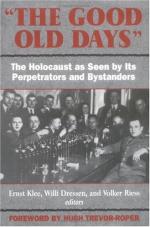
5. What language was 'The Good Old Days' translated from?
(a) Hebrew.
(b) German.
(c) Slovak.
(d) French.
Short Answer Questions
1. What do the documents of "Pushed to their psychological limits" say some executioners suffered from?
2. What are the three documents about presented in "Pushed to their psychological limits"?
3. When did the events in "Soldiers sitting on rooftops and platforms watching the show" take place?
4. What food did the doctors in Auschwitz like in the camp?
5. Who is in the first photograph in "Each time a victim was beaten to death they started to clap"?
Short Essay Questions
1. What did a customs official say regarding the organization of the murders in Vinnitsa and Brailov?
2. What did the Jager Report recommend?
3. What does the material start and end with, according to the "Foreword"?
4. What was a bizarre note of concern regarding mass executions?
5. What did Landau provide good example of?
6. What was "Once again I've got to play general to the Jews" an excerpt of?
7. What were some problems regarding the gas vans?
8. Who was the cycle unit that participated in mass killing of Jews supported by?
9. Who was Oberst and what did he recount?
10. What concern did the German government have regarding German soldiers during the war?
|
This section contains 603 words (approx. 3 pages at 300 words per page) |
|





