
 Print
Print Word
Word PDF
PDF

|
| Name: _________________________ | Period: ___________________ |
This test consists of 15 multiple choice questions and 5 short answer questions.
Multiple Choice Questions
1. Who did the Lithuanians blame for the foreign occupation of their country?
(a) The Jews.
(b) The Nazi party of Lithuania.
(c) The Communists.
(d) The Germans.
2. How did the Lithuanians see the German invasion of their country?
(a) As a disaster.
(b) As a liberation.
(c) With indifference.
(d) As a danger for the Jews.
3. What did the German government use as an excuse to escalate the hatred for the Jews?
(a) Fear of the communists.
(b) Reaction to partisan sabotage.
(c) Propaganda.
(d) Their wealth.
4. How were the bodies of the Babi Yar ravine massacre disposed of?
(a) They were burnt.
(b) They were individually buried.
(c) In mass graves.
(d) They were thrown in the sea.
5. What do the statements forming "Quite happy to take part in shootings" not show?
(a) People willing to not follow orders.
(b) Official persecution of those who refused to participate in the Holocaust.
(c) Willingness of particular individuals to save Jews.
(d) Willingness from the government to exterminate the Jews.
6. What method of execution followed shooting the victims while waiting for the industrial solutions to be put in place?
(a) Zyklon B.
(b) Asphyxiation.
(c) Drowning.
(d) Gas vans.
7. Where did the events in "Present at the execution with heads of other authorities" take place?
(a) Stranbeck.
(b) Kiev.
(c) Bobruisk.
(d) Rostov.
8. What does the account of the Babi Yar ravine massacre note wandered into villages in the day following the massacre?
(a) Victims that unearthed themselves.
(b) Crying soldiers.
(c) Dogs with body parts.
(d) Drunk S.S. soldiers.
9. How many Jewish Lithuanians were killed in June 1941?
(a) 2,000.
(b) 1,500.
(c) 1,000.
(d) 3,000.
10. How many Jews died in the Babi Yar ravine massacre?
(a) 3,771.
(b) 33,771.
(c) 371.
(d) 3,371.
11. What was the second method used by Nazis to kill Jews?
(a) Gas planes.
(b) Gas chamber.
(c) Shooting.
(d) Gas vans.
12. Where did the battalion deploy described in the third document of "The brutalization of precious German Manpower"?
(a) Kiev and Warsaw.
(b) Warsaw and Minsk.
(c) Berlin and Minsk.
(d) Rostov and Kiev.
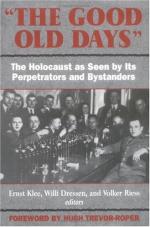
13. What period of history does the majority of The Good Old Days deal with?
(a) Pre WWII.
(b) Post death camp
(c) Post WWII.
(d) Pre-gassing and cremation.
14. What often happened during the mass shooting of Jews?
(a) Some tried to overpower the guards.
(b) Men tried to bargain for their life.
(c) Local people came to watch.
(d) Parents killed their children.
15. Why did the German government allow Lithuanians to mass murder Jews?
(a) Because they arrived too late to prevent it.
(b) Because it was politically preferable to doing it themselves.
(c) Because the Lithuanians asked permission.
(d) Because they didn't know about it.
Short Answer Questions
1. What did a soldier have to overcome while killing the Jewish prisoners?
2. What camp were the Jews of Olkusz/Ilkenau sent to?
3. What do the documents of "Pushed to their psychological limits" say some executioners suffered from?
4. Where was the author of "Once again I've got to play general to the Jews" located according to his journal?
5. What does the "Introduction" provide a concise review of?
|
This section contains 501 words (approx. 2 pages at 300 words per page) |
|





