
 Print
Print Word
Word PDF
PDF

|
| Name: _________________________ | Period: ___________________ |
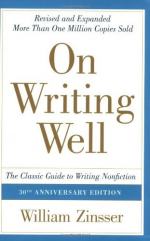
This quiz consists of 5 multiple choice and 5 short answer questions through Part III: Chapter 11 Nonfiction as Literature.
Multiple Choice Questions
1. When can ornamental writing be used as an exception?
(a) When the wrting needs extra fluff.
(b) When the author needs to abide by editors remarks.
(c) When writing evaluations and resumes.
(d) To follow solid writing.
2. What is Zissner's point of view on the debate between literature and journalism?
(a) He wants to go back to the pre-WWII form of writing.
(b) He agrees that journalism is bad writing.
(c) He agrees that literature is the only true form of good writing.
(d) He believes it doesn't matter, and that good writing is good writing.
3. What does Zinsser do before submitting a piece of writing?
(a) He edits everything three times.
(b) He reads everything aloud.
(c) He has his wife read his work.
(d) He submits his writing to his family.
4. What is a strange but effective way of proofreading to check for errors?
(a) Reading a piece backwards.
(b) Reading under a blacklight.
(c) Reading through a window.
(d) Reading a story upside down.
5. What are the best aspects of a good story?
(a) Clarity and writing skill.
(b) Clarity.
(c) Good research.
(d) Writing skill.
Short Answer Questions
1. How does a writer become better at his craft?
2. Why is it important to narrow down a nonfiction piece?
3. Why does Zissner advise his clients to worry about the marketplace last?
4. What is an example of a dead language?
5. What could cause a writer to write unclear?
|
This section contains 381 words (approx. 2 pages at 300 words per page) |
|





