
 Print
Print Word
Word PDF
PDF

|
| Name: _________________________ | Period: ___________________ |
This test consists of 5 multiple choice questions and 5 short answer questions.
Multiple Choice Questions
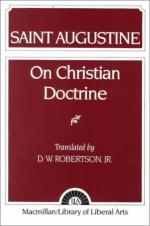
1. What does Augustine state an interpreter sometimes looks to to get the right meanings and right number of meanings from a passage?
(a) The history of the period that the Scripture was recorded.
(b) The original language.
(c) The original manuscripts.
(d) The author's intentions.
2. What are the primary possessions of the student of Scripture, according to Augustine in Book Two?
(a) Special gifts, things, and signs.
(b) Faith, hope, and love.
(c) Love, illuminated truth, and the inner eye.
(d) Illuminated truth, the inner eye, and faith.
3. Even though Augustine does not mention this subject directly, what will his students need to master to understand languages?
(a) Grammar.
(b) Dialects.
(c) Metaphors.
(d) Regional accents.
4. From what type of education does Augustine develop his curriculum of Scriptural learning?
(a) A classical education.
(b) A Hasidic education.
(c) A Nazarene education.
(d) An ecclesiastical education.
5. What does Augustine recommend as methods for handling the topic in Book Three?
(a) Exclusive study of Scripture and submission to the proper guidance from church officials as methods of handling the problem of book two.
(b) Theological virtue and great learning as methods of handling the problem of Book Two.
(c) Seclusion from secular temptations to allow for the maturation of the "inner eye" as methods of handling the problem of book two.
(d) Strict adherence to the dietary laws of Israel and understanding of prophecy as methods of handling the problem of book two.
Short Answer Questions
1. According to Augustine, to whom are commands from Scripture intended?
2. According to Augustine in Book Three, what is a condition that affects holy men and God's commands of them?
3. What is the most important step Augustine's students must take to avoid the trap he sees in interpretation?
4. What was the topic of Book Three?
5. Why does Augustine claim this knowledge is required to understand what Scripture teaches?
|
This section contains 545 words (approx. 2 pages at 300 words per page) |
|





