
 Print
Print Word
Word PDF
PDF

|
| Name: _________________________ | Period: ___________________ |
This test consists of 15 multiple choice questions and 5 short answer questions.
Multiple Choice Questions
1. What does Deborah begin to eat for dinner after returning from the cotton mill in the beginning of “Life in the Iron Mills”?
(a) Boiled cabbage
(b) Pork sausage
(c) Haggis and rice
(d) Boiled potatoes
2. What night of the week is it that Deborah brings Hugh his dinner at the mill in the beginning of “Life in the Iron Mills”?
(a) Sunday
(b) Tuesday
(c) Saturday
(d) Monday
3. The church that Hugh enters on the night he decides to keep the money is described by the narrator of “Life in the Iron Mills” as what?
(a) An epic cathedral
(b) A somber Gothic pile
(c) A medieval rapture
(d) A Gregorian haunt
4. Dr. May says in “Life in the Iron Mills,” “That is true philosophy. Drift with the stream, because you cannot” what?
(a) Swim against the current
(b) Face the harshness of the deep
(c) Answer for the current
(d) Dive deep enough to find bottom
5. How does the narrator describe the weather in the opening of “Life in the Iron Mills”?
(a) Arid
(b) Cloudy
(c) Sunny
(d) Windy
6. What word used in “Life in the Iron Mills” refers to a side of cured pork?
(a) Bandy
(b) Curry
(c) Flitch
(d) Haggis
7. What is the name of the overseer that comes with the visiting men to the mill in “Life in the Iron Mills”?
(a) Mr. Mitchell
(b) Mr. Clarke
(c) Mr. Kirk
(d) Mr. Wolfe
8. Where does Deborah hide the money she’s stolen when Hugh falls asleep after they’ve arrived home from the mill in “Life in the Iron Mills”?
(a) In her apron pocket
(b) In Hugh’s pocket
(c) In her jewelry box
(d) In the attic
9. The mill where Hugh works in “Life in the Iron Mills” is described as being by the river and how far below the city-limits?
(a) ½ mile
(b) 2 miles
(c) 10 miles
(d) 1 mile
10. What deformity is Deborah said to be afflicted with in “Life in the Iron Mills”?
(a) She is an amputee
(b) She is hunchbacked
(c) She is deaf
(d) She is blind
11. The mill where Hugh Wolfe works makes iron for what in “Life in the Iron Mills”?
(a) War weaponry
(b) Railroads
(c) Skyscrapers
(d) Steam ships
12. Janey tells Deborah that “the father” is in the stone house with whom in the beginning of “Life in the Iron Mills”?
(a) Paul
(b) Henderson
(c) Haley
(d) Peters
13. What word from “Life in the Iron Mills” means given or characterized by joking?
(a) Implicit
(b) Ephemeral
(c) Extrapolated
(d) Jocose
14. What broken figure does the narrator describe as “pointing upward from the mantle shelf” in the beginning of “Life in the Iron Mills”?
(a) A tiger
(b) An angel
(c) A lion
(d) A goddess
15. Rebecca Harding Davis is credited with over how many published works?
(a) 20
(b) 500
(c) 50
(d) 100
Short Answer Questions
1. The woman who stays behind at the jail after Hugh’s suicide is described as a Quaker or what, “as they call themselves” in “Life in the Iron Mills”?
2. The narrator in “Life in the Iron Mills” describes Hugh Wolfe as “A morbid, gloomy man, untaught, unled, left to feed his soul in” what?
3. The narrator in “Life in the Iron Mills” describes “man’s law” as that “which seizes on one” what?
4. The narrator compares the “wild, eager face” of the sculpture in “Life in the Iron Mills” to what?
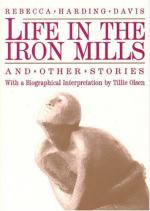
5. Who wrote “A Biographical Interpretation” of Rebecca Harding Davis’s “Life in the Iron Mills”?
|
This section contains 587 words (approx. 2 pages at 300 words per page) |
|





