
 Print
Print Word
Word PDF
PDF

|
| Name: _________________________ | Period: ___________________ |
This quiz consists of 5 multiple choice and 5 short answer questions through A Biographical Interpretation.
Multiple Choice Questions
1. Of Deborah, the narrator says in “Life in the Iron Mills,” “Perhaps the weak, flaccid wretch had some stimulant in her pale life to keep her up—some love or hope, it might be, or urgent need. When that stimulant was gone, she would take to” what?
(a) The river
(b) Opium
(c) Lacquer
(d) Whiskey
2. The narrator in “Life in the Iron Mills” describes Hugh Wolfe as “no favorite in the mill; he had the taint of” what on him?
(a) School-learning
(b) Politics and corruption
(c) Old money
(d) Secrecy and politeness
3. The narrator tells the reader in the beginning of “Life in the Iron Mills,” I will tell you plainly that I have a great hope; and I bring it to you to be” what?
(a) Digested
(b) Embraced
(c) Tested
(d) Remembered
4. How does the narrator describe Hugh Wolfe’s face in “Life in the Iron Mills”?
(a) A meek, woman’s face
(b) A sly and jovial young man’s face
(c) A round and glowing face
(d) A haggard face with slyness like a snake
5. Where does the narrator say she keeps the korl statue in the end of “Life in the Iron Mills”?
(a) In a museum
(b) In a bank vault
(c) On the front porch
(d) Behind a curtain
Short Answer Questions
1. Who was the publisher that accepted “Life in the Iron Mills” immediately and began a long friendship with Rebecca Harding Davis?
2. The mill where Hugh Wolfe works makes iron for what in “Life in the Iron Mills”?
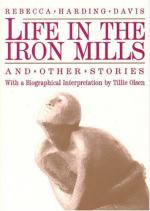
3. Who wrote “A Biographical Interpretation” of Rebecca Harding Davis’s “Life in the Iron Mills”?
4. What Biblical figure, the son of Isaac, does the narrator denote having been deprived of his birthright in “Life in the Iron Mills”?
5. The author of “A Biographical Interpretation” states that Rebecca Harding Davis grew up along what river?
|
This section contains 331 words (approx. 2 pages at 300 words per page) |
|





