
 Print
Print Word
Word PDF
PDF

|
| Name: _________________________ | Period: ___________________ |
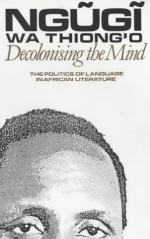
This quiz consists of 5 multiple choice and 5 short answer questions through Chapter 1 (Parts VI-IX): "The Language of African Literature" .
Multiple Choice Questions
1. What was the elitist institution for Africans in colonial Kenya where Ngũgĩ wa Thiong’o attended high school?
(a) The Ndebele High School.
(b) The Niflheim High School.
(c) The Alliance High School.
(d) The Oxford High School.
2. What statement largely sums up the author's central theme in Chapter 1, Part IV?
(a) Communication creates culture, and culture is a means of communication.
(b) Culture and communication are unnecessary.
(c) Culture reflects history and communication carries history.
(d) Culture creates communication, and communication is a means to culture.
3. What does the word "axiomatic" mean, as used in Chapter 1, Part I?
(a) Subjugating.
(b) Mean-spirited.
(c) Self-evident.
(d) Arbitrary.
4. What did Sydney Portier say he had come to associate Africa with as a result of the literature he had read?
(a) Lions.
(b) Snakes.
(c) Witches.
(d) Tigers.
5. What novel of the author's did he hope to give a transcript of to Chinua Achebe at the writers' conference described in Chapter 1, Part II?
(a) The River Between.
(b) Caitaani mũtharaba-Inĩ.
(c) A Grain of Wheat.
(d) Weep Not, Child.
Short Answer Questions
1. When did the Kenya Land and Freedom Army usher in the era of modern guerilla warfare in Africa?
2. What does the author refer to as the result of the broken harmony between the three aspects of language as communication for the colonial child?
3. When did Gakaara wa Wanjaũ earn the Noma Award for his secret diary he kept while in political detention?
4. When was there a declaration of a state of emergency over Kenta that led to all schools being run by the colonial regime?
5. Where did the capitalist powers of Europe carve up the continent of Africa into different colonies in the late 1800s?
|
This section contains 276 words (approx. 1 page at 300 words per page) |
|





