
 Print
Print Word
Word PDF
PDF

|
| Name: _________________________ | Period: ___________________ |
This test consists of 5 short answer questions, 10 short essay questions, and 1 (of 3) essay topics.
Short Answer Questions
1. What does Sean MacStiofain say revolutions are caused by, in the first place?
2. How many lives does Gladwell say Reynolds feel like he saved?
3. How does Gladwell say André Trocmé circumvented the Nazi requirement to salute the Nazi flag at the school?
4. How much does Gladwell say the odds increase, that a child of an incarcerated parent will have a psychiatric disorder?
5. What does Gladwell say was the result when Montreal police went on strike for 16 hours in 1969?
Short Essay Questions
1. What does Gladwell say were the circumstances that led to Freireich’s father death?
2. What does Gladwell say happened in Montreal when the police went on strike?
3. Where had Kellen gotten his background for the RAND job to consult on the Vietnam war?
4. What was the effect of the Three Strikes law in California?
5. What does Gladwell say would have happened had the Nazis killed André Trocmé?
6. How does Wyatt Walker say he had to adjust his tactics to the situation at hand?
7. How does Gladwell explain Freireich’s wife’s bond to him?
8. What does Stella get wrong about teaching in the video Gladwell refers to, from the Curry School of Education at the University of Virginia?
9. What was Mike Reynolds’ reaction when his daughter Kimber was shot and killed by a meth addict?
10. How did Freireich compensate for the isolation that came from experimenting in the way he did?
Essay Topics
Write an essay for ONE of the following topics:
Essay Topic 1
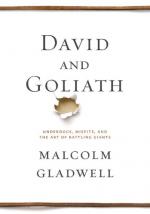
Write an evaluative review of David and Goliath. What is this book’s place in our culture? Who will find this book most useful? What are its uses? What are its limitations?
Essay Topic 2
Evaluate your own reading of David and Goliath—did you resist it, or were you compelled by the story? What does your reading tell you about yourself and your interests? Use specific examples from the book to describe yourself as a reader.
Essay Topic 3
When is David and Goliath most itself? What is its characteristic passage, or moment? What makes that moment or passage the most representative of the book as a whole? Are there any places where the book seems to depart from its typical self, as if to become a different book?
|
This section contains 981 words (approx. 4 pages at 300 words per page) |
|





