
 Print
Print Word
Word PDF
PDF|
This section contains 267 words (approx. 1 page at 400 words per page) |

|
Anowa Summary & Study Guide Description
Anowa Summary & Study Guide includes comprehensive information and analysis to help you understand the book. This study guide contains the following sections:
This detailed literature summary also contains Bibliography and a Free Quiz on Anowa by Ama Ata Aidoo.
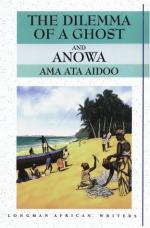
Anowa is the second, last, and most accomplished play written by Ghanaian playwright, poet, short story writer, and novelist Ama Ata Aidoo. Anowa was first published in 1970 and had its British premiere in London in 1991; Aidoo had begun writing Anowa in the late 1960s. Aidoo based the play on regional legends and folktales, some of which were about the "disobedient daughter." In such stories, a young woman refuses to marry a suitor, resulting in disaster. Aidoo gave such stories her own twist, incorporating a more complicated portrayal of gender and drawing parallels with contemporary Ghanaian history. At the center of the play is the title character, Anowa, who finds her own husband and remains true to her own ideals, resulting in an unhappy marriage and conflict that leads to death.
Set in the 1870s, many critics believe that Anowa underscores the similarities between the slave trade occurring in the Gold Coast (as Ghana was then known) in that time period and the treatment of women in contemporary society. Some believe Anowa is feminist, while others focus on the economic aspects. Most agree that it is thoroughly modern in the dilemmas it presents. As Mildred A. Hill-Lubin writes in her essay "Ama Ata Aidoo and the African Diaspora: Things 'All Good Men and Women Try to Forget,' but I Will Not Let Them" (included in Emerging Perspectives on Ama Ata Aidoo, 1999), "Anowa . . . combines the political and the personal and demonstrates the interconnectedness of race, gender, and economic oppressions. It reveals the complicity of Africans in the slaves trade, notes the cover-up in terms of silence."
Read more from the Study Guide
|
This section contains 267 words (approx. 1 page at 400 words per page) |
|




