 Print
Print Word
Word PDF
PDF|
This section contains 3,403 words (approx. 12 pages at 300 words per page) |

|
by William Styron
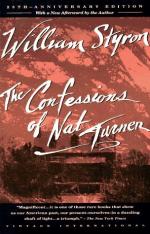
William Styron, a white writer and novelist, was born in 1925 in Newport News, Virginia, the same tidewater region where the real Nat Turner lived one hundred years earlier. Styron's grandmother grew up on a North Carolina plantation, where she owned two slave girls. The hours spent listening to his grandmother's stories about owning slaves haunted the young Styron for years. It troubled him deeply that by his own time racial inequalities still had not been set right. In 1966, during the midst of the growing black civil rights movement, Styron published The Confessions of Nat Turner, one of his most controversial novels. The book, which focused on the life and rebellion of a black slave in nineteenth-century Virginia, helped shed light on the racial unrest that persisted into the twentieth century.
Events in History at the Time the Novel Takes Place
|
This section contains 3,403 words (approx. 12 pages at 300 words per page) |
|