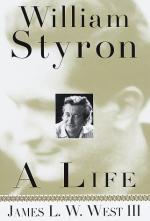
Styron, William (1925—)
The novels of William Styron have won major literary awards, received tremendous popular attention, and been the subject of controversy. Styron's two best known n...
Read more
Biography EssayThe critics received Lie Down in Darkness (1951) as an auspicious first novel, perhaps the best to appear since World War II. If reminiscent of Faulkner, its style was distinctly the au...
Read more

William Styron (born 1925) was a Southern writer of novels and articles. His major works were Lie Down in Darkness,The Long March, The Confessions of Nat Turner, and Sophie's Choice. His major theme w...
Read more
The critics received Lie Down in Darkness (1951) as an auspicious first novel, perhaps the best to appear since World War II. Its style, if reminiscent of Faulkner, was distinctly the author's own; it...
Read more
William Styron 's first novel, Lie Down in Darkness (1951), placed him in the vanguard of promising young American authors of the post-World War II era, along with such writers as J. D. Salinger, Nor...
Read more
William Styron is a major American novelist who has won wide critical acclaim and stirred controversy by addressing culturally and historically contentious issues. Though not a prolific writer, he has...
Read more
Critical Essay by Welles T. Brandriff
[During The Long March] Mannix has been physically disabled and is about to be socially ostracized (at least by a part of society). But there has been no comparab...
Read more
Critical Essay by Ardner R. Cheshire, Jr.
A man on his judgment day, reflecting on his moral responsibility for past actions and the possibility of redemption—this is an important motif not onl...
Read more
Critical Essay by Richard Gray
Since the time he started writing, it seems to have been [Styron's] conscious aim to perpetuate the great tradition in Southern literature, and to assume the thro...
Read more
Critical Essay by Frederick J. Hoffman
It is futile to stir up the old clichés about "decadence," "Southern tradition," the "Southern model," etc. Styr...
Read more
Critical Essay by Alvin H. Rosenfeld
The American Muse dictates its own terms of refashioning reality, and almost always these will take a highly personal, even solipsistic turn. One prominent example...
Read more
Critical Essay by Arnold Wesker
[William Styron] has hazarded a novel, Sophie's Choice, which attempts to defy the notion (George Steiner) that "in the presence of certain realities art ...
Read more
In the following excerpt, McNamara finds that the plot, structure, and metaphors of Styron's novella demonstrate the author's point that both acceptance of and obedience to authority are...
Read more
Here, Ruderman observes that Mannix, by virtue of his suffering and indomitable will against the impersonality of the military, achieves a heroic triumph.
Three of Styron's major works of ficti...
Read more
In this excerpt, Coale examines Styron's polarized vision of rebellion and authority, particularly what he sees as Styron's confusion over whether to portray the rebellious individual as...
Read more
In this review of A Tidewater Morning, Kakutani notes Styron's skillful handling of the themes of mortality and evil, but observes that the collection is largely interesting as an index to his ...
Read more
In the following evaluation of A Tidewater Morning, Bausch praises the way in which the three stories compliment each other and together "make one ineffable glow, like facets of the same dark j...
Read more
In this excerpt, Eder extols Styron's deft interweaving of historical occurrences, Southern legend, and his own autobiographical experiences in A Tidewater Morning.
Styron has not published muc...
Read more
Below, Leader concludes that, in writing the stories contained within A Tidewater Morning, Styron sought to achieve personal integrity.
The pivotal moment in each of the three linked stories in Willia...
Read more
In this essay, which first appeared as the introduction to the Norwegian edition of The Long March in 1975, Styron discusses the autobiographical experiences that inform his work and recounts his own ...
Read more
In this excerpt, West discusses the effect of Styron's revisions of these earlier published stories and notes that Styron's message is that art can redeem an otherwise intolerable existe...
Read more
Here, Curran finds in Styron's latest collection an essential optimism that underlies the dark and painful fictionalized memories of the author's boyhood.
"We each devise our mean...
Read more
In this excerpt, Cologne-Brookes sees in The Long March signs of a change in Styron's emphases, from his earlier view that literature is a way to achieve harmony in a chaotic world to his later...
Read more
In this excerpt, Finkelstein discusses Styron's novella in the context of the Cold War period, and he notes what he considers Styron's accurate portrayal of the military's complet...
Read more
In the following assessment of The Long March, Walcutt argues that the author had to sacrifice characterization and credibility to get his point across.
In his novelette The Long March . . . William S...
Read more
In this excerpt, Brandriff describes The Long March as the story of one man's tortured discovery of the disorder and chaos that underlie the surface of civilization.
There is a natural tendency...
Read more
Below, Nigro argues that The Long March is about the degeneration of a classical hero type into an "anti-hero" due to the corruption of the military. The critic also suggests that the mi...
Read more
In this excerpt, Hays demonstrates how Styron's language and symbolism make Mannix a mythic figure comparable to Prometheus and Christ.
William Styron's The Long March presents us with ...
Read more
Below, Ratner provides an overview of the techniques and symbolism that Styron uses in The Long March "enlarging the narrative into his general theme of rebellion."
Styron's nove...
Read more
In the excerpt below, Malin discusses symbolism, characterization, and Styron's use of body imagery and contrast.
The opening paragraph of The Long March tells us much about the symbols, theme...
Read more
In this excerpt from an interview that was originally published in 1977, Styron speaks of how his resentment of authority figures has been a significant feature of his writing.
[West]: The themes that...
Read more