BookRags.com Literature Guides Literature
Guides
Criticism & Essays Criticism &
Essays
Questions & Answers Questions &
Answers
Lesson Plans Lesson
Plans
My Bibliography Periodic Table U.S. Presidents Shakespeare Sonnet Shake-Up
Research Anything:        
History | Encyclopedias | Films | News | Create a Bibliography | More... Login | Register | Help

Not What You Meant?  There are 8 definitions for Boolean.

George Boole

Print-Friendly  Order the PDF version  Order the RTF version
About 2 pages (516 words)
George Boole Summary

Bookmark and Share Know this topic well? Help others and get FREE products!

George Boole

1815-1864

English Mathematician

George Boole was an English mathematician who was among the founders of modern symbolic logic. His algebra of logic, which has come to be called Boolean algebra, is basic to the design of digital computers.

Boole was born on November 2, 1815, in Lincoln, England. His father was a tradesman, and taught him how to make optical instruments, as well as the rudiments of mathematics. A local bookseller taught him Latin. Aside from this early training and a few years at local schools. Boole was self-educated. He had to earn an income to help support his family, and by the age of 20 he was an experienced schoolteacher with his own school in Lincoln. In his limited free time, he studied mathematics, including such classic works as Isaac Newton's (1642-1727) Principia, Pierre Simon de Laplace's (1749-1827) Traité de mécanique céleste, and Joseph Louis Lagrange's (1736-1813) Mecanique analytique.

Beginning in 1839, Boole submitted a number of papers to the Cambridge Mathematical Journal. This new journal was edited by Duncan Gregory, who acted as Boole's mentor. In 1844, Boole published an important paper in the Philosophical Transactions of the Royal Society, on using algebraic methods to solve differential equations. The paper resulted in his being awarded the Society's Royal Medal.

Boole soon realized that algebra could be applied to logic as well. In 1847, he published a pamphlet entitled Mathematical Analysis of Logic, arguing that logic should be considered a branch of mathematics rather than a branch of philosophy. A more complete treatment of his symbolic logic was published in 1854 as An Investigation into the Laws of Thought, on Which are Founded the Mathematical Theories of Logic and Probabilities.

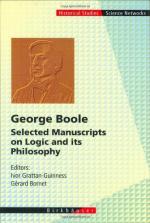
George Boole. (The Library of Congress. Reproduced by permission.)George Boole. (The Library of Congress. Reproduced by permission.)

The key to Boole's system of symbolic logic, which came to be known as Boolean algebra, was the separation of the symbols of operation from those of quantity. The operational symbols, such as + , can be used to represent logical relationships and operations. Symbols expressing quantity are not used in Boolean logic because it is a two-valued system referring only to the presence or absence of some attribute. This is generally expressed as one and zero, on and off, or true and false.

Despite his lack of a university degree, Boole was appointed a professor of mathematics at Queen's College in Ireland in 1849 on the strength of his published work. Later he was elected a Fellow of the Royal Society. In 1855, he married Mary Everest, the niece of mountaineer George Everest. They had five daughters.

In addition to his work on symbolic logic, Boole wrote two influential books, the Treatise on Differential Equations (1859) and the Treatise on the Calculus of Finite Differences (1860). These were used as university texts for many years.

Boole remained at Queen's College for the rest of his life, and enjoyed a reputation as an excellent teacher. Unfortunately, his career started late and ended early, when he died at the age of 49, on December 8, 1864, of a feverish coldthat progressed to pneumonia. However, his work is the foundation upon which the Information Age was built.

This is the complete article, containing 516 words (approx. 2 pages at 300 words per page).

More Information
  • View George Boole Study Pack
  • 8 Alternative Definitions
  • Search Results for "George Boole"
  • Add This to Your Bibliography
  • More Products on This Subject
    George Boole
    The English mathematician George Boole (1815-1864) invented mathematical, or symbolic, logic and un... more

    George Boole
    George Boole was the founder of the modern science of mathematical logic. He devised a system of bi... more


    Ask any question on George Boole and get it answered FAST!
    Answer questions in BookRags Q&A and earn points toward
    discounted or even FREE Study Guides and other BookRags products!
    Learn more about BookRags Q&A
    Copyrights
    George Boole from Science and Its Times. ©2005-2006 Thomson Gale, a part of the Thomson Corporation. All rights reserved.

    Join BookRagslearn moreJoin BookRags


    About BookRags | Customer Service | Report an Error | Terms of Use | Privacy Policy