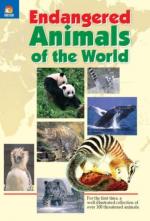
Endangered Species
An "endangered species" under United States law (the Endangered Species Act [1973]) is a creature "in danger of extinction throughout all or a significant portion of its range." A "threatened" species is one that is likely to become endangered in the foreseeable future.
For most people, the endangered species problem involves the plight of such well-known animals as eagles, tigers, whales, chimpanzees, elephants, wolves, and whooping cranes. However, literally millions of lesser-known or unknown species are endangered or becoming so, and the loss of these life forms could have even more profound effects on humans than that of large mammals with whom we more readily identify and sympathize.
Most experts on species extinction, such as Edward O. Wilson of Harvard and Norman Myers, estimate current and projected annual extinctions at anywhere from 15,000 to 50,000 species, or 50 to 150 per day, mainly invertebrates such as insects in tropical rain forests. At this rate, 5–10% of the world's species, perhaps more, could be lost in the next decade and a similar percentage in coming decades.
The single most important common threat to wildlife worldwide is the loss of habitat, particularly the destruction of biologically-rich tropical rain forests. Additional factors have included commercial exploitation, the introduction of non-native species, pollution, hunting, and trapping. Thus, we are rapidly losing a most precious heritage, the diversity of living species that inhabit the earth. Within one generation, we are witnessing the threatened extinction of between one fifth and one half of all species on the planet.
Species of wildlife are becoming extinct at a rate that defies comprehension and threatens our own future. These losses are depriving this generation and future ones of much of the world's beauty and diversity, as well as irreplaceable sources of food, drugs, medicines, and natural processes that are or could prove extremely valuable, or even necessary, to the well-being of our society.
Today's rate of extinction exceeds that of all of the mass extinction in geologic history, including the disappearance of the dinosaurs 65 million years ago. It is impossible to know how many species of plants and animals we are actually losing, or even how many species exist, since many have never been "discovered" or identified. What we do know is that we are rapidly extirpating from the face of the earth countless unique life forms that will never again exist.
Most of these species extinctions will occur—and are occurring—in tropical rain forests, which are the richest biological areas on earth and are being cut down at a rate of 1–2 acres (0.4–0.8 ha) a second. Although tropical forests cover only about 5–7% of the world's land surface, they are thought to contain over half of the species on earth.
There are more bird species in one Peruvian preserve than in the entire United States. There are more species of fish in one Brazilian river than in all the rivers of the United States. And a single square mile in lowland Peru or Amazonian Ecuador or Brazil may contain over 1500 species of butterflies, more than twice as many as are found in all of the United States and Canada. Half an acre of Peruvian rain forest may contain over 40,000 species of insects.
Eric Eckholm in Disappearing Species: The Social Challenge notes that when a plant species is wiped out, some 10–30 dependent species can also be jeopardized, such as insects and even other plants. An example of the complex relationship that has evolved between many tropical species is the 40 different kinds of fig trees native to Central America, each of which has a specific insect pollinator. Other insects, including pollinators for other plants, depend on certain of these fig trees for food.
Thus, the extinction of one species can set off a chain reaction, the ultimate effects of which cannot be foreseen. As Eckholm puts it, "Crushed by the march of civilization, one species can take many others with it, and the ecological repercussion and arrangements that follow may well endanger people." The loss of so many unrecorded, unstudied species will deprive the world not only of beautiful and interesting life forms, but also much-needed sources of medicines, drugs, and food that could be of critical value to humanity. Every day, we could be losing plants that could provide cures for cancer or AIDS or could become food staples as important as rice, wheat, or corn. We will simply never know the value or importance of the untold thousands of species vanishing each year.
As of spring of 2002, the U.S. Department of the Interior's list of endangered and threatened species included 1,070 animals (mammals, birds, reptiles, amphibians, fish, snails, clams, crustaceans, insects, and arachnids), and 746 plants, for a total of 1816 endangered or threatened species.
Under the Endangered Species Act, the Department of the Interior is given general responsibility for listing and protecting endangered wildlife, except for marine species (such as whales and seals), which are the responsibilities of the Commerce Department.
In addition, the United States is subject to the provisions of the Convention on International Trade in Endangered Species of Wild Flora and Fauna (CITES), which regulates global commerce in rare species. But in many cases, the government has not been enthusiastic about administering and enforcing the laws and regulations protecting endangered wildlife. Conservationists have for years criticized the Interior Department for its slowness and even refusal to list hundreds of endangered species that, without government protection, were becoming extinct. Indeed, the Department admits that some three dozen species have become extinct while undergoing review for listing.
In December 1992, the department settled a lawsuit brought by animal protection groups by agreeing to expedite the listing process for some 1300 species and to take a more comprehensive "multispecies, ecosystem approach" to protecting wildlife and their habitat. In October 1992, at the national conference of the Humane Society of the United States held in Boulder, Colorado, the Secretary of the Interior Bruce Babbitt in his keynote address lauded the Endangered Species Act as "an extraordinary achievement," emphasized the importance of preserving endangered species and biological diversity, and noted: "The extinction of a species is a permanent loss for the entire world. It is millions of years of growth and development put out forever."
Biodiversity
Resources
Books
Mitchell, G. J. World on Fire: Saving an Endangered Earth. New York: Charles Scribner's Sons, 1991.
Myers, N. The Sinking Ark: A New Look at Disappearing Species. Oxford: Pergamon Press, 1979.
Porritt, J. Save the Earth. Atlanta: Turner Publishing, 1991.
Raven, P. H. "Endangered Realm." In The Emerald Realm. Washington, DC: National Geographic Society, 1990.
Wilson, E. O., ed. Biodiversity. Washington, DC: National Academy Press, 1988.
Other
"Endangered and Threatened Wildlife and Plants." U. S. Department of the Interior. Federal Register (29 August 1992).
This is the complete article, containing 1,109 words
(approx. 4 pages at 300 words per page).