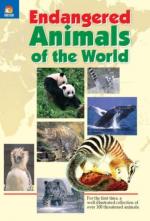
Endangered Species
An endangered species is one that is likely to become extinct throughout all or part of its geographic range unless steps are taken to prevent its loss. Many of the species currently disappearing are tropical plants and insects that have not even been described by science but whose small ranges are being destroyed by deforestation. These species may contain valuable pharmaceuticals which could lead to cures for diseases, but they are also the irreplaceable products of millions of years of evolution.
The U.S. Endangered Species Act (ESA) protects any endangered species as well as the critical habitat on which it relies. Critical habitat does not necessarily include the entire ecosystem across the species' range. The ESA is the strongest ecological law in the world today because it has the power to restrict or eliminate human impact across an entire species range. Because the economic stakes can be high, officially designating a species as endangered can be a controversial process.
Given the costs of protecting endangered species, it is crucial to be certain that species are in fact endangered. The first step is to document a decline in population number. Doing so requires at least two population samples, using the same sampling methods, at different times. Even if a particular population shows no sign of decline, the species as a whole may decline as a result of range contraction and local population extinction; for example, deforestation eliminates whole populations while others remain intact.
Causes of Decline
Once a decline is established, the cause must be identified. First, natural history must be investigated in order to construct a list of possible agents. These may include prey extinction, pollutants, habitat change, habitat fragmentation, overharvesting, introduced species, disease, or inbreeding depression. Diagnosis requires the elimination of alternative hypotheses by observation and experiment.
A classic case of population decline was the decline and extinction of ten species of forest birds in Guam in the late 1960s. Pesticide use, hunting, competition from introduced bird species, habitat change, and disease were all measured and found to be uncorrelated with population densities of the forest birds. The only variable that was correlated with the decreaseof the birds' range was the range of the brown tree snake, a species that was accidentally introduced to the island via an airplane wheel well in 1967. Subsequent live bait trapping indicated that brown tree snake predation on forest birds was higher where the birds were declining. An associated prediction that the snake would cause small mammal populations to decline was also supported.
The bald eagle, an enduring symbol of the United States, remains an endangered species.
Habitat Change.
Habitat change is any change in the suite of resources and environmental conditions on which a species depends. It is not enough to know that habitat change or loss is causing species decline; the particular factors relevant to the species must be discovered. For example, the northern spotted owl nests in the tops of dead firs. These "snags" are commonly found in old-growth forests. Young forests provide marginal habitat. Nevertheless, understanding the owl's behavior, hunting habits, nesting habits, and other factors may allow some human activity in owl habitat without endangering the owl.
Habitat Fragmentation.
This is a particularly harmful form of habitat change. Fragmentation is the loss of bits and pieces of habitat because of human activity, resulting in a patchwork habitat. Not only does this reduce the overall species range, it also changes the ratio of edge habitat to central habitat. For example, tropical forest fragmentation favors species that specialize in relatively open, sunny spaces such as treefalls, rather than the cooler, darker forest. This may cause forest specialists to decline as a result of competition as well as habitat loss. Demonstrating an effect of habitat fragmentation on population decline requires documenting fragment sizes and population densities.
Introduced Species.
Introduced species, such as the brown tree snake, have been responsible for 40 percent of all extinctions. The Nile perch, introduced into Lake Victoria (located in east Africa) in the nineteenth century,caused the extinction of 200 species of cichlid by predation. To detect the impact of an introduced species, the timing of the introduction is compared to that of population decline. If there is a correlation, an experiment must demonstrate that the removal of the introduced species reverses the decline. Removal may involve surrounding the endangered species habitat with fencing or by poisoning the suspected introduced species. Unfortunately, it is difficult to remove a single species from a habitat without changing other variables. And introduced species, once established, are nearly impossible to eradicate.
Chains of extinction can make the diagnosis of species decline more complex. For example, Mauritanian kestrels declined because geckos, their food source, were eliminated by deforestation. Atlantic eelgrass limpets disappeared when a mold killed the eelgrass in which they lived. Black-footed ferrets declined along with their prey, the prairie dog. Saving one species may require saving several others as well.
Environmental Contaminants.
These may also play a role in species decline. The mechanism by which organochlorides, such as DDT, can cause eggshell thinning in raptors was discovered in the 1960s, and DDT was soon banned in the United States and other countries. Blaming a chemical for the decline of a species, however, can result in banning a harmless substance while ignoring the actual problem. For example, eggshell thinning due to insufficient calcium deposition occurred in the Netherlands in the 1980s, well after DDT had been banned. Further investigation concluded that acid rain had leached calcium from the soil, reducing the amount found in the calcium carbonate shells of snails; the birds were unable to obtain sufficient calcium from feeding on snails.
Disease.
This factor is thought to have contributed to the decline of many species. Infections can cross from one species to another (called transspecies infections); for example, an introduced species can carry novel pathogens with it into a community that has evolved no resistance to it. Often, disease is the result of stress on the species' immune system from another source, such as pollution. Although the disappearance of amphibians around the world remains a mystery, it is likely exacerbated by the effect of acid rain on immune function in aquatic species. Establishing such a connection requires investigating beyond the appearance of disease into underlying causes.
Hunting.
Overharvesting occurs when the number of individuals lost to hunting consistently exceeds the number gained from intrinsic population growth in the absence of harvesting. Overharvesting is a particularly difficult factor to measure because both annual harvests and population sizes vary in time and space. Furthermore, hunting yields are often underreported, especially if they are illegal.
Inbreeding Depression.
This may be a factor in the decline of a population once the number of individuals is small. Inbreeding depression is the result of closely related individuals breeding, causing recessive harmful mutations to be passed on by both parents and therefore be expressed in subsequent generations. There is no evidence that inbreeding depression has ever caused extinction in the wild, though it can be a problem for captive-bred populations. It is likely that once a population is small enough for inbreeding depression to become relevant, extinction is inevitable for other reasons.
The Northern Spotted Owl
The case of the northern spotted owl in the Pacific Northwest region of the United States illustrates many of the issues surrounding the designation of an endangered species. The species is currently listed as threatened, meaning that it is at risk of becoming endangered in the foreseeable future. Its critical habitat is old-growth and late-successional forest with a dense canopy and open understory, which it requires for successful roosting. Such forests are extremely valuable to the timber industry. Since the spotted owl was listed as threatened in 1990, debate raged in the Pacific Northwest over the relative merits of a protection plan and the logging industry it would impact. At the beginning of the twenty-first century, there was no plan to protect the species, even though it was known that habitat destruction due to logging had caused the species' decline.
The current rate of extinction is greater than at any time in the last 65 million years. There have been only about five such mass extinctions in the history of the Earth, and they all occurred as a result of catastrophic changes in the environment. At no other time has the practices of a single species, humans, caused so many extinctions.
Ddt; Extinction; Exotic Species; Habitat Loss; Habitat Restoration; Threatened Species.
Bibliography
Caughley, Graeme. Conservation Biology in Theory and Practice. Cambridge, MA: Blackwell Science, 1996.
Sutherland, William J., ed. Conservation Science and Action. Malden, MA: Blackwell Science, 1998.
This is the complete article, containing 1,411 words
(approx. 5 pages at 300 words per page).