The term ecosystem was coined in 1935 by the Oxford ecologist Arthur Tansley to encompass the interactions among biotic and abiotic components of the environment at a given site. It was defined in its presently accepted form by Eugene Odum as follows: "Any unit that includes all of the organisms (i.e, the community) in a given area interacting with the physical environment so that a flow of energy leads to clearly defined trophic structure, biotic diversity, and material cycles (i.e., exchange of materials between living and non-living parts) within the system." Tansley's concept had been expressed earlier in 1913 by the Oxford geographer A. J. Herbertson, who suggested the term "macroorganism" for such a combined biotic and abiotic entity. He was, however, too far in advance of his time and the idea was not taken up by ecologists. On the other hand Tansley's concept—elaborated in terms of the transfer of energy and matter across ecosystem boundaries–was utilized within the next few years by Evelyn Hutchinson, Raymond Lindeman, and the Odum brothers, Eugene and Howard.
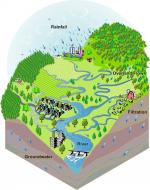
The boundaries of an ecosystem can be somewhat arbitrary, reflecting the interest of a particular ecologist in studying a certain portion of the landscape. However, such a choice may often represent a recognizable landscape unit such as a woodlot, a wetland, a stream or lake, or—in the most logical case—a watershed within a sealed geological basin, whose exchanges with the atmosphere and outputs via stream flow can be measured quite precisely. Inputs and outputs imply an open system, which is true of all but the planetary or global ecosystem, open to energy flow but effectively closed in terms of materials except in the case of large-scale asteroid impact.
Ecosystems exhibit a great deal of structure, as may be seen in the vertical partitioning of a forest into tree, shrub, herb, and moss layers, underlain by a series of distinctive soil horizons. Horizontal structure is often visible as a mosaic of patches, as in forests with gaps where trees have died and herbs and shrubs now flourish, or in bogs with hummocks and hollows supporting different kinds of plants. Often the horizontal structure is distinctly zoned, for instance around the shallow margin of a lake; and sometimes it is beautifully patterned, as in the vast peatlands of North America that reflect a very complicated hydrology.
Ecosystems exhibit an interesting functional organization in their processing of energy and matter. Green plants, the primary producers of organic matter, are consumed by herbivores, which in turn are eaten by carnivores that may in turn be the prey of other carnivores. Moreover, all these animals may have parasites as another set of consumers. Such sequences of producers and successive consumers constitute a food chain, which is always part of a complicated, inter-linked food web along which energy and materials pass. At each step along the food chain some of the energy is egested or passed through the organisms as feces. Much more is used for metabolic processes and—in the case of animals—for seeking food or escaping predators; such energy is released as heat. As a consequence only a small fraction (often of the order of 10%) of the energy captured at a given step in the food chain is passed along to the next step.
There are two main types of food chains. One is made up of plant producers and animal consumers of living organisms, which constitute a grazing food chain. The other consists of organisms that break down and metabolize dead organic matter, such as earthworms, fungi, and bacteria. These constitute the detritus food chain. Humans rely chiefly on grazing food chains based on grasslands, whereas in a forest it is usual for more than 90% of the energy trapped by photosynthesis to pass along the detritus food chain.
Whereas energy flows one way through ecosystems and is dispersed finally to the atmosphere as heat, materials are partially and often largely recycled. For example, nitrogen in rain and snow may be taken up from the soil by roots, built into leaf protein that falls with the leaves in autumn, there to be broken down by soil microbes to ammonia and nitrate and taken up once again by roots. A given molecule of nitrogen may go through this nutrient cycle again and again before finally leaving the system in stream outflow. Other nutrients, and toxins such as lead and mercury, follow the same pathway, each with a different residence time in the forest ecosystem.
Mature ecosystems exhibit a substantial degree of stability, or dynamic equilibrium, as the endpoint of what is often a rather orderly succession of species determined by the nature of the habitat. Sometimes this successional process is a result of the differing life spans of the colonizing species, at other times it comes about because the colonizing species alter the habitat in ways that are more favorable to their competitors, as in an acid moss bog that succeeds a circumneutral sedge fen that has in its turn colonized a pond as a floating mat. Equilibrium may sometimes be represented on a large scale by a relatively stable mosaic of small-scale patches in various stages of succession, for instance in fire-dominated pine forests. On the millennial time scale, of course, ecosystems are not stable, changing very gradually owing to immigration and emigration of species and to evolutionary changes in the species themselves.
The structure, function, and development of ecosystems are controlled by a series of partially independent environmental factors: climate, soil parent material, topography, the plants and animals available to colonize a given site, and disturbances such as fire and windthrow. Each factor is, of course, divisible into a variety of components, as in the case of temperature and precipitation under the general heading of climate.
There are many ways to study ecosystems. Evelyn Hutchinson divided them into two main categories, holistic and meristic. The former treats an ecosystem as a "black box" and examines inputs, storages, and outputs, for example in the construction of a lake's heat budget or a watershed's chemical budget. This is the physicist's or engineer's approach to how ecosystems work. The meristic point of view emphasizes analysis of the different parts of the system and how they fit together in their structure and function, for example the various zones of a wetland or a soil profile, or the diverse components of food webs. This is the biologist's approach to how ecosystems work.
Ecosystem studies can also be viewed as a series of elements. The first is, necessarily, a description of the system, its location, boundaries, plant and animal communities, environmental characteristics, etc. Description may be followed by any or all of a series of additional elements, including: 1) a study of how a given ecosystem compares with others locally, regionally, or globally; 2) how it functions in terms of hydrology, productivity, and biogeochemical cycling of nutrients and toxins; 3) how it has changed over time; and 4) how various environmental factors have controlled its structure, function, and development. Such studies involve empirical observations about relationships within and among ecosystems, experiments to test the causality of such relationships, and model-building to assist in forecasting what may happen in the future.
The ultimate in ecosystem studies is a consideration of the structure, function, and development of the global or planetary ecosystem, with a view to understanding and mitigating the deleterious impacts upon it of current human activities.