 Print
Print Word
Word PDF
PDF|
This section contains 4 words (approx. 1 page at 300 words per page) |
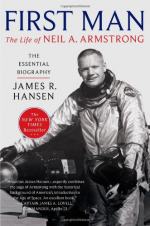
 When Neil Armstrong became the first human on the Moon, he uttered the famous words: "That's one small step for man . . . one giant leap for mankind."
American Astronaut; First Human on the Moon 1930-
Born in Wapakoneta, Ohio, on August 5, 1930, Neil Alden Armstrong became a naval aviator in 1949. He received a bachelor of science degree in aeronautical engineering from Purdue University in 1955 and a master of sciences degree in aerospace engineering from the University of Southern California in 1970. Armstrong received an honorary doctorate in engineering from Purdue in 1970 and has been awarded additional honorary doctorates by various universities since that time.
In 1955 Armstrong became a research test pilot for the National Aeronautics and Space Administration (NASA) assigned to the X-15 rocket plane program. NASA selected Armstrong to be an astronaut in 1962. On March 16, 1966, Armstrong and Dave Scott were launched in Gemini 8 to conduct the first two-craft linkup in space, docking with a target satellite named Agena. Apollo 11 astronauts Armstrong, Edwin "Buzz" Aldrin, and Mike Collins left for the Moon on July 16, 1969. Armstrong and Aldrin landed their lunar module "Eagle" in the Moon's Sea of Tranquility four days later, on July 20. Armstrong stepped onto the surface and became the first human to set foot on the Moon.
Armstrong left NASA in 1971 and became a professor of aeronautical engineering at the University of Cincinnati, where he taught until 1981. He is currently the chairman of Computing Technologies for Aviation, Inc. (CTA).
Astronaut Candidates See Career Astronauts (Volume 1).
Astronaut Corps See Career Astronauts (Volume 1).
See Also
Aldrin, Buzz (Volume 1);; Apollo (Volume 3);; Apollo Lunar Landing Sites (Volume 3);; History of Humans in Space (Volume 3).
Bibliography
Chaikin, Andrew L. A Man on the Moon: The Voyages of the Apollo Astronauts. Alexandria, VA: Time-Life Books, 1998.
Ellis, Lee A. Who's Who of NASA Astronauts. New York: Americana Group Publishing, 2001.
Internet Resources
|
This section contains 4 words (approx. 1 page at 300 words per page) |