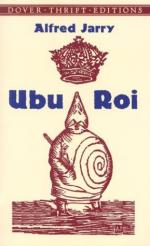
Alfred Jarry's life and work are both wildly separated and inextricably connected. The varied nature of his writing makes his work as a whole difficult to assimilate. Jarry is widely regarded as an icon of the modern theater. His best-known play is the i...
The life and work of Alfred Jarry, both of which are enigmatic, complex, and at times undecipherable, mark a watershed in French theatrical history. Jarry's best-known play, Ubu Roi (1896; translated as Ubu Roi, 1951), was a revolutionary work that intro...
Ubu Roi (King Ubu) is a play developed by Alfred Jarry. It was premiered in 1896, and is widely acknowledged as a theatrical precursor to the Absurdist, Dada and Surrealist art movements. It is the first of three plays written throughout Jarry's life...
Every drama student knows the story of "Ubu Roi." The absurdist play caused a sensation -- and nearly a riot -- when it opened in Paris in December 1896: The first word of dialogue was a vulgar term for excrement that had never been...
Nineteenth-century French artist/playwright Henry Somm and Alfred Jarry used their plays to defy the bourgeoisie. They endeared their plays to the underprivileged by assaulting conventional rules of taste, and by using scatological imagery. Somm's 'La Berline de l'emigre' offered definite class differentiation on the...
In the following essay, Jannarone argues that the 1896 production of Ubu Roi represents a complicated mixture of folk culture and highbrow art, and suggests that Jarry envisioned his audience in a more complex way than did other Symbolist artists.
In the following essay, Perry traces the echoes of Shakespeare's Macbeth in Jarry's surreal Ubu Roi, and then examines the ways in which both Macbeth and Ubu inform Eugène Ionesco's absurdist Macbett.
In the following essay, Vickroy demonstrates that Julia Kristeva's theory of “semiotic motility”—which does not presuppose that meaning preceding language—provides a useful methodology for reading Jarry's Ubu Roi, which creates neologisms with the effect of undercutting preconceptions about meaning and symbol.
Get the complete Ubu Roi Study Pack, which includes everything but the lesson plans listed on this page. Approximately 222 pages (at 300 words per page) in 12 products. (Download a sample literature guide)