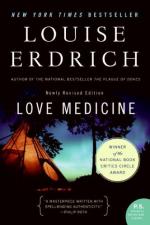
Love Medicine
by Louise Erdrich
Louise Erdrich belongs to the Turtle Mountain Band of Chippewa. She was born in Little Falls, Minnesota, in 1954 and raised in Wahpeton, North Dakota, a region near ...
Read more
Biography EssayThe writings of Louise Erdrich not only reflect her multilayered, complex background but also confound a variety of literary genre and cultural categories. Although she is known primari...
Read more
Once named one of People magazine's most beautiful people, Louise Erdrich (born 1954) is a Native American writer with a wide popular appeal. She is no literary lightweight, however, having drawn comp...
Read more
Like William Faulkner and his Yoknapatawpha County, American writer Louise Erdrich has created her own mythical landscape in and around Argus, a fictional Red River Valley reservation town on the Minn...
Read more
The families Louise Erdrich first introduced in a short story, "The World's Greatest Fishermen" (1982) -- the Kashpaws, the Lamartines, the Pillagers, and the Morrisseys -- have also appeared in four ...
Read more
Louise Erdrich is one of the most important contemporary Native American writers. She writes poetry and some of the most sophisticated fiction and nonfiction being produced in the United States; her n...
Read more
The writings of Louise Erdrich not only reflect her multilayered, complex background but also confound a variety of literary genre and cultural categories. Although she is known primarily as a success...
Read more
In the following review, MacDougall praises Erdrich's characterizations in Love Medicine, calling the work “a funny, mystical and down-to-earth” novel.
I grew up with [my mothe...
Read more
In the following review, Taylor compliments Erdrich's narrative structure and examination of issues relevant to Native Americans in Love Medicine.
Set in North Dakota and depicting the lives...
Read more
In the following essay, Gleason examines how humor is used as a metaphor and as a tool for emotional growth in Love Medicine.
We have one priceless universal trait, we Americans. That trait is our ...
Read more
In the following essay, Barry and Prescott examine gender and social roles within Native American communities in Love Medicine, contending that “Erdrich challenges the romantic vision of Native...
Read more
In the following essay, Flavin asserts that Love Medicine is a novel about “disintegration and breaking connections, and of bonding and restoration.”
Louise Erdrich's Love Medi...
Read more
In the following essay, Magalaner maintains that Erdrich's primary focus in Love Medicine is on her characters and their relationships within the Turtle Mountain community.
Love Medicine mar...
Read more
In the following essay, Silberman places Love Medicine within the context of late twentieth-century Native American literature, arguing that Erdrich's novel signals a break with traditional mod...
Read more
In the following essay, Schultz explores the function of multiperspectivity in Love Medicine.
In the early part of the twentieth century, multiperspectivity in fiction was seen as elitist and exper...
Read more
In the following excerpt, Owens discusses the dominant thematic concerns of Love Medicine, particularly the novel's examination of race and religion.
Despite the importance of N. Scott Momad...
Read more
In the following essay, Sarris offers a critical reading of Love Medicine, using Erdrich's text to explore aspects of Native American literature.
“Your grandmother didn't want ...
Read more
In the following essay, Zeck examines the sensual relationship between the characters of Eli and Marie in Love Medicine.
In the chapter of Louise Erdrich's novel Love Medicine entitled ...
Read more
In the following essay, Pittman explores how Erdrich uses time and space to create a narrative world in Love Medicine, noting that “[discovering the literary and cultural features essential to ...
Read more
In the following excerpt, Smith investigates Erdrich's use of the Native American trickster archetype in Love Medicine.
The trickster's constant chatterings and antics remind us that ...
Read more
In the following essay, Farrell provides an interpretation of the symbolism behind June's death in the “The World's Greatest Fishermen” chapter of Love Medicine.
Set mos...
Read more
In the following essay, McKinney explores the negative influence of Catholic missionaries on the Chippewa people and the impact of Catholicism in Erdrich's Love Medicine.
In the last decade ...
Read more
In the following essay, Sutton discusses the recurring image of the red convertible in Love Medicine.
Literary critic Marvin Magalaner has stated that in Louise Erdrich's Love Medicine, ...
Read more
In the following essay, Stokes explores the role of Anishinabe culture, mythology, and storytelling in Love Medicine.
Even though she grew up off-reservation speaking English, and writes a novel, a...
Read more
In the following essay, Gish identifies how hunting functions as a central motif in Love Medicine.
Now therefore take, I pray thee, thy weapons, thy quiver and thy bow, and go out to the field, and...
Read more
In the following essay, Chavkin compares and contrasts Erdrich's original version of Love Medicine with the 1993 expanded edition, noting similarities and differences throughout the text.
Lo...
Read more
In the following essay, Ratcliffe considers Erdrich's portrayal of addiction in Love Medicine and discusses some of the difficulties she had teaching the novel—a problem she refers to as...
Read more
In the following essay, Mitchell explores the ways in which Cormac McCarthy's Blood Meridian and Erdrich's Love Medicine debunk the mythology of the American West.
“Fighting; h...
Read more
In the following essay, Sands considers stylistic aspects of Love Medicine, maintaining that “ultimately it is a novel, a solid, nailed-down, compassionate, and coherent narrative that uses sop...
Read more
Teaching Love Medicine
All teaching products sold separately.
Love Medicine Lesson Plans contain 152 pages of teaching material, including: