 Print
Print Word
Word PDF
PDF|
This section contains 1,418 words (approx. 5 pages at 300 words per page) |

|
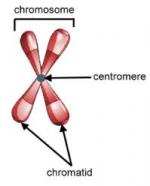
Chromosomes are microscopic units containing organized genetic information, located in the nuclei of diploid and haploid cells (e.g., human somatic and sex cells), and are also present in one-cell non-nucleated organisms (unicellular microorganisms) such as bacteria, which do not have an organized nucleus. The sum-total of genetic information contained in different chromosomes of a given individual or species are generically referred to as the genome.
In humans, chromosomes are structurally made of roughly equal amounts of proteins and DNA. Each chromosome contains a double-strand DNA molecule, arranged as a double helix, and tightly coiled and neatly packed by a family of proteins called histones. DNA strands are comprised of linked nucleotides. Each nucleotide has a sugar (deoxyribose), a nitrogenous base, plus one to three phosphate groups. Each nucleotide is linked to adjacent nucleotides in the same DNA strand by phosphodiester bonds. Phosphodiester is another sugar, made of...
|
This section contains 1,418 words (approx. 5 pages at 300 words per page) |
|