
 Print
Print Word
Word PDF
PDF

|
| Name: _________________________ | Period: ___________________ |
This test consists of 5 short answer questions, 10 short essay questions, and 1 (of 3) essay topics.
Short Answer Questions
1. What does Wooden believe will happen if you don't work as hard as you can toward a life goal?
2. Wooden feels that a person should never do what?
3. What does Wooden think of people trying to achieve goals that will or could harm themselves?
4. Where does Wooden feel personal glory comes into play when it comes to being on a team?
5. What does it mean when an athlete gets an endorsement offer?
Short Essay Questions
1. What does Wooden think will happen if a person's goals are impossible to attain?
2. For whom does Wooden show great respect during Part 1 of "Wooden"?
3. Describe Wooden's philosophy of "perfection."
4. Why does Wooden make his team members have the same hair cut and uniform?
5. Describe John and Nellie Wooden's marriage.
6. Wooden believes that the media has made winning different. Why?
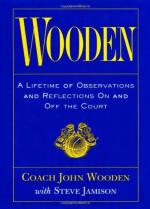
7. What is the basic focus of the beginning of the book "Wooden"?
8. Why does Wooden call himself a "realistic optimist"?
9. How does Wooden describe his parents?
10. Why does Wooden run his basketball team like he runs his household?
Essay Topics
Write an essay for ONE of the following topics:
Essay Topic 1
How does Wooden ensure that all the players he coaches are ready to be successful in the following areas:
1. Athletically.
2. Mentally.
3. As a team.
4. Individually.
5. Spiritually.
Essay Topic 2
Wooden tells the reader at the beginning of the book that he has a love for literature. How is his love for literature apparent at three different times during the text of "Wooden'? (Example: The use of poetry throughout "Wooden" shows that Wooden loves the written word and is familiar with many types of poems as well as authors.)
Essay Topic 3
Wooden describes his pyramid of success using the power of imagery and allusion. How else is imagery and allusion used in another place in "Wooden"? (Example: The image/allusion of the basketball team as a family.)
|
This section contains 691 words (approx. 3 pages at 300 words per page) |
|





