
 Print
Print Word
Word PDF
PDF

|
| Name: _________________________ | Period: ___________________ |
This test consists of 5 multiple choice questions, 5 short answer questions, and 10 short essay questions.
Multiple Choice Questions
1. In what town did the author attend primary school?
(a) Nsukka.
(b) Akure.
(c) Lagos.
(d) Abuja.
2. What was Louis's reaction to the man's words after receiving his tip?
(a) He was angry.
(b) He was surprised.
(c) He was amused.
(d) He was proud.
3. How did the author meet Okoloma?
(a) They worked together.
(b) They were distant cousins and met at a family reunion.
(c) They grew up on the same street.
(d) They met at a rally for social justice.
4. How does the author describe the town in which she attended primary school?
(a) As a working class town.
(b) As a sleepy little town.
(c) As a university town.
(d) As a farming town.
5. Because the author had not known what the word feminist meant the first time it was applied to her, she planned to do what the moment she arrived home?
(a) Look up the word in the encyclopedia.
(b) Ask her brother the meaning of the word.
(c) Look up the word in the dictionary.
(d) Ask her mother the meaning of the word.
Short Answer Questions
1. In what country was the author's original TED Talk about feminism given?
2. Whom did the man in Lagos thank for the tip given to him by the author?
3. The author describes Lagos as having more entrepreneurial spirit than what city?
4. The author says that she had read every published Mills and Boon book before she had turned what age?
5. What does the author give as the reason for why the man in Lagos had believed what he had about the source of the author's money?
Short Essay Questions
1. Who tells Adichie that calling herself a feminist means that she hates men and why is this source significant?
2. What is ironic about the teacher's statement that the class monitor of course had to be a boy and that she had thought this fact would be "obvious" (10)?
3. What were the duties of the class monitor at Adichie's primary school?
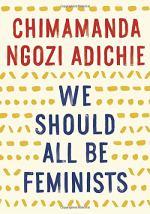
4. From what source was Chimamanda Ngozi Adichie's essay We Should All Be Feminists adapted?
5. What examples does Adichie provide for her claims that if we see or "do the same thing over and over, it becomes normal"? (10)
6. How does Adichie characterize Louis's views on gender before the tipping incident?
7. What exposition does Adichie provide within her anecdote about the role of class monitor?
8. What conclusion does Adichie reach as a result of awarding herself the title of "Happy African Feminist Who Does Not Hate Me and Who Likes to Wear Lip Gloss and High Heels For Herself and Not For Men" (9)?
9. How does Adichie employ self-deprecating humor in her anecdote about the Nigerian journalist?
10. Describe the occasion when Adichie was first called a feminist and how she received the comment.
|
This section contains 1,184 words (approx. 4 pages at 300 words per page) |
|





