
 Print
Print Word
Word PDF
PDF

|
| Name: _________________________ | Period: ___________________ |
This test consists of 5 multiple choice questions, 5 short answer questions, and 10 short essay questions.
Multiple Choice Questions
1. What strategy was Karen Strier opposed to using, for preserving the muriqui population?
(a) Relocating some families. Working with the muriqui families on an individual basis.
(b) Breeding the muriqui in captivity.
(c) Hunting down poachers.
(d) Imposing limits on environmental encroachment.
2. Which theory is Quammen supporting when he cites the work of William Newmark?
(a) The keep reserves close together model.
(b) The keep reserves apart model.
(c) The many small reserves model.
(d) The single large reserve model.
3. What is a minimum viable population?
(a) The minimum number of offspring that need to be born in each brood to sustain the population.
(b) The minimum rate of increase to preserve the genetic health of a population.
(c) The number of individuals necessary to sustain a population.
(d) The minimum number of acres necessary to preserve a population.
4. Where does Quammen say the theory of island ecology now applies?
(a) In caves.
(b) In microclimates.
(c) In mountainous regions.
(d) In the mainlands as well.
5. What does Lawrence Abele study?
(a) Komodo dragons.
(b) Tasmanian tigers.
(c) Birds.
(d) Coral.
Short Answer Questions
1. What environment is NOT analogous to an island, according to Quammen?
2. What observation did Wilson make to Quammen?
3. Where did Lovejoy implement his plan?
4. How was the minimum viable population theory applied in Texas?
5. What was Quammen told to find, in order to observe this species?
Short Essay Questions
1. How is the case of the muriqui different from the case of the Mauritius kestrel?
2. How does Quammen describe Bedo's death?
3. What did Simberloff and Abele propose as a result of their data?
4. Why did Quammen choose Aru as the destination for his final chapter?
5. What is the definition of 'viable' in Quammen's account?
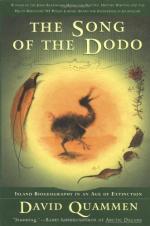
6. What note does Quammen end 'The Song of the Dodo' on?
7. What was Quammen looking for at Aru?
8. What does Quammen say about applying the case of the Mauritius kestrel to other species?
9. What experiment took place in the Florida Keys?
10. How does Quammen describe the indri?
|
This section contains 786 words (approx. 3 pages at 300 words per page) |
|





