
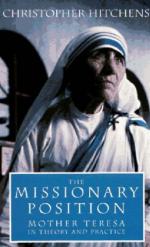
 Print
Print Word
Word PDF
PDF

|
| Name: _________________________ | Period: ___________________ |
This test consists of 5 multiple choice questions and 5 short answer questions.
Multiple Choice Questions
1. Who wrote the short story, "The Free Radio" in East, West?
(a) Susan Shields.
(b) Salman Rushdie.
(c) Emily Lewis.
(d) Christopher Hitchens.
2. What expression does Washington vernacular still contain in honor of the United State Senators who did an infamous con man favors while receiving vast campaign donations in the form of other people's money?
(a) Fox four.
(b) Keating Five.
(c) Maxwell Seven.
(d) John-Roger Three.
3. Where did Mother Teresa address a vast open-air mass in Ireland in 1992?
(a) Belfast.
(b) Knock.
(c) Waterford.
(d) Dublin.
4. What is actually abortifacient in the fundamentalist definition of the term?
(a) Chemotherapy.
(b) Alchoholism in pregnant women.
(c) Intrauterine contraception.
(d) Child neglect.
5. Whose methods of deception were "false prospectus" and "political bribe"?
(a) Robin Fox.
(b) John-Roger.
(c) Robert Maxwell.
(d) Charles Keating.
Short Answer Questions
1. Who does the author attribute this point to, "There should be philosophy and knowledge for the elect, religion and sentimentality for the masses?"
2. Which author wrote of how Mother Teresa unexpectedly received an amount of money on the same day that it was needed in a biography?
3. Which award, worth a quarter of a million lire, was presented to Mother Teresa in 1979 by the president of Italy?
4. Who publicly represents the Christian fundamentalist cohort, founded by Pat Robertson?
5. In the Afterword, who is mentioned as having observed that the prevalent modes of worship in the Roman world were "considered by the people as equally true, by the philosopher as equally false, and by the magistrate as equally useful?"
|
This section contains 289 words (approx. 1 page at 300 words per page) |
|





