
 Print
Print Word
Word PDF
PDF

|
| Name: _________________________ | Period: ___________________ |
This test consists of 15 multiple choice questions and 5 short answer questions.
Multiple Choice Questions
1. The author shares that by this time, he has established what?
(a) A large following.
(b) A bank account.
(c) Enough of a reputation to satisfy himself.
(d) A small following.
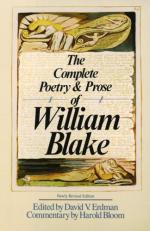
2. This set of writings is listed in the Complete Poetry & Prose of William Blake under Roman numeral ____.
(a) X.
(b) IX.
(c) V.
(d) IV.
3. Blake also made what that he hoped to sell as art?
(a) Prints.
(b) Photographs.
(c) Sculptures.
(d) Paintings.
4. Why have the inscriptions been included?
(a) So lovers of art will understand the connection between Blake's poems and visual art.
(b) So that students can better understand Blake's work.
(c) So Blake would feel his work was being adequately taught.
(d) So that passionate fans of William Blake's can learn more about him through his artwork.
5. What is another recurring image?
(a) Humans being taken by animals.
(b) Animals being taken by other animals.
(c) Animals being taken by humans.
(d) Humans being taken by other humans.
6. Here again there are many what?
(a) Short stories.
(b) Epic tales.
(c) Sets of poems.
(d) Individual poems.
7. This begins as a ____________ the preceding summary chapter.
(a) Change from.
(b) A contrast to.
(c) A diversion from.
(d) Continuation of.
8. Blake takes readers to this spiritual space that somehow defies normal comprehension by giving what impression?
(a) It does not exists.
(b) It exists somewhere on Earth.
(c) It is a unique and fantasy world.
(d) It both exists and does not exist at the same time.
9. The author plants _____________ truths into the verses of the second page.
(a) Simple.
(b) Unique.
(c) Interesting.
(d) Sexual.
10. After those are a string of further poems that seem designed how?
(a) To be taken on their own.
(b) To support one another.
(c) To explain the previous poems.
(d) To support the previous poems.
11. In the poem, Summer, each stanza is progressively ______________ than the one before it.
(a) More convoluted.
(b) More simplistic.
(c) Longer.
(d) Shorter.
12. How many of these poems taken on their own or in the small groups are sufficient to constitute an entire epic?
(a) One.
(b) Three.
(c) None.
(d) Two.
13. The evil ones in the poetic stories have been those who are ___________ the idea that the mind has greater power than what comes to be presented to the human senses as objects of the world.
(a) Against.
(b) For.
(c) Unsure of.
(d) Sure of.
14. Describe the stanzas of the first of these.
(a) Interesting.
(b) Simplistic.
(c) Ornate.
(d) Overdone.
15. This portion is devoted to what?
(a) The last of the Days of the Four Zoas.
(b) The last of the Nights of the Four Zoas.
(c) The last of the Evenings of the Four Zoas.
(d) The last of the Mornings of the Four Zoas.
Short Answer Questions
1. Unlike the others, ___________________ exhibits entire poetic stanzas designed to accompany visual art.
2. How are the poems labeled in their sequence?
3. He uses his powers to do what?
4. This is amended, thematically, shortly thereafter with, "Thus Urizen spoke collected himself in awful pride / space / Art though visionary of Jesus the soft delusion of Eternity / Lo I am __________________________________." (p. 307).
5. After the Mad Song, there are two simply called what?
|
This section contains 538 words (approx. 2 pages at 300 words per page) |
|





