
 Print
Print Word
Word PDF
PDF

|
| Name: _________________________ | Period: ___________________ |
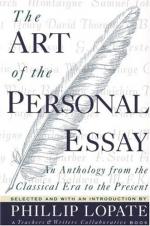
This quiz consists of 5 multiple choice and 5 short answer questions through Chapter 3, The Rise of the English Essay- Page 113-211.
Multiple Choice Questions
1. Which place did Charles Lamb occupy amongst his siblings?
(a) He was an only child.
(b) He was the youngest.
(c) He was the eldest.
(d) He was the middle child.
2. What is Cowley's message in his essay "Of Greatness"?
(a) One should be content with little things.
(b) Large things are impressive to the senses, and create awe.
(c) Men are either born great, or they have greatness thrust upon them.
(d) Wealth and power are the two factors that influence happiness.
3. What is wrong with the child in "Of A Monstrous Child?"
(a) The child was born badly deformed.
(b) The child had both male and female sexual organs.
(c) The child was born with three eyes.
(d) The child is a criminal and menace to the town.
4. To what character may many of Montaigne's writings may be considered similar to?
(a) Platonic.
(b) Stoic.
(c) Optimistic.
(d) Anti-Semitic.
5. What is Montaigne's view on quoting and crediting other authors?
(a) Montaigne plagiarizes large portions of his essays, and does not credit the original author.
(b) Montaigne feels it is a weakness to quote others; one's work should be the product of original thought.
(c) Montaigne relies upon other authors' works, and quotes them regularly.
(d) Montaigne quotes others' works, but he frequently confuses the author or mangles the original quotation.
Short Answer Questions
1. How was Montaigne's first book received?
2. What is the disposition of the eunuch Montaigne describes in "Of a Monstrous Child?"
3. Who wrote "An Hour or Two Sacred to Sorrow?"
4. What does Montaigne conclude in "Of a Monstrous Child?"
5. Why prompted Montaigne to retire from his career to pursue writing?
|
This section contains 359 words (approx. 2 pages at 300 words per page) |
|





