
 Print
Print Word
Word PDF
PDF

|
| Name: _________________________ | Period: ___________________ |
This test consists of 5 multiple choice questions, 5 short answer questions, and 10 short essay questions.
Multiple Choice Questions
1. What does Sly shout back at the band in "Africa Talks to You 'the Asphalt Jungle'"?
(a) "Help."
(b) "Timber."
(c) "I'm a dying."
(d) "Stop."
2. Who wrote "Hound Dog"?
(a) Elvis Presley.
(b) Robert Johnson.
(c) Jerry Leiber and Mike Stoller.
(d) Carl Perkins.
3. What did Seale attempt to use as a political threat?
(a) Petitions.
(b) Criminal violence.
(c) Peaceful marches.
(d) The judicial system.
4. In "Elvis," what song does Elvis make his own by changing the story from hopelessness to hope?
(a) "Hound Dog. "
(b) "Baby Let's Play House."
(c) "Pink Cadillac."
(d) "Mystery Train."
5. What does Marcus point out as valuable in the Beach Boys music?
(a) It is truthful.
(b) It is poetic.
(c) It reflects everyday people.
(d) It criticizes mainstream society.
Short Answer Questions
1. What controversial topics are addressed in Randy Newman's song "Sail Away"?
2. What archetype does Newman represent?
3. What did RCA first present Elvis as?
4. How many people came to see Elvis open a shopping center after he produced only one record?
5. What was Elvis called in the beginning of his career?
Short Essay Questions
1. According to Marcus in the section "Sly Versus Superfly," why does Riot matter?
2. According to Marcus in "Elvis," what are Elvis Presley's roots?
3. What does Marcus mean when he wrote: "Instead of breaking the bartender's glass Stack found himself aiming at the mirror behind the bar, and thus discovered that the target was himself" (78)?
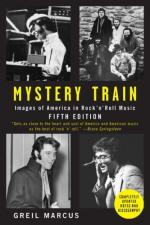
4. Why did Marcus entitle a section "Mystery Train" in "Elvis"? Why is this also the title of the book?
5. In the section "Sly vs. Superfly," what problems emerge from the black movies being made in the early seventies? How is real life different from the movies?
6. Describe Randy Newman's style; what does he sound like? What influences are in the music?
7. In "Elvis," Marcus compares Elvis Presley to Abraham Lincoln, why?
8. In "Randy Newman," does Randy Newman care if he is popular or not?
9. According to Marcus in "Sly Stone," why did Sly Stone create the album Riot ?
10. Why was "Short People" so controversial? What did this mean for Newman?
|
This section contains 1,197 words (approx. 4 pages at 300 words per page) |
|





