
 Print
Print Word
Word PDF
PDF

|
| Name: _________________________ | Period: ___________________ |
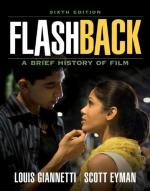
This quiz consists of 5 multiple choice and 5 short answer questions through Flashback: A Brief History of Film Chapters 5-8.
Multiple Choice Questions
1. Which of the following was not one of the the Big Five studios in the Golden Age of the Studio?
(a) Universal.
(b) Warner Bros.
(c) Paramount.
(d) RKO.
2. What group was formed in 1908 with the intention to further develop the Kinetoscope technology?
(a) Screen Actors Guild.
(b) The Film D'Art.
(c) American Federation of Television and Radio Actors.
(d) Actor's Equity.
3. What aspect of the newly-heard dialogue in the Golden Age made audiences uneasy?
(a) The strange voices of previously-silent stars.
(b) The political aspects.
(c) Sexual innuendo.
(d) The accents of foreign stars.
4. What early realization helped films develop both special effects and story lines?
(a) The films should be longer.
(b) Reels could be cut together.
(c) Cameras could be operated by one man.
(d) Filming the weather was not intriguing enough for audiences.
5. In the first several decades of the film industry, European films focused on the artists, while American films focused on the _______.
(a) Sociological value.
(b) Political statements.
(c) Story.
(d) Entertainment.
Short Answer Questions
1. Through what did Jean Louis Meissonier project Muybridge's work?
2. During the early days of World War II, why did Britain have trouble maintaining their film industry?
3. Which of the following comedians was not one of the silent film stars from the 1920s?
4. For what company did Griffith work?
5. The two main regions involved in film production before the move to California were New York and _________.
|
This section contains 247 words (approx. 1 page at 300 words per page) |
|





