
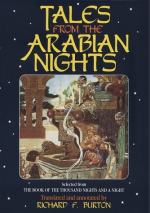
The Book of the Thousand Nights and a Night — Volume 16 eBook

This eBook from the Gutenberg Project consists of approximately 591 pages of information about The Book of the Thousand Nights and a Night — Volume 16.

The Book of the Thousand Nights and a Night — Volume 16 eBook

This eBook from the Gutenberg Project consists of approximately 591 pages of information about The Book of the Thousand Nights and a Night — Volume 16.
work which costs a guinea a volume, and in which the manners, the customs, and the language of the East are boldly represented as they were and as they are.  Such critics Captain Burton, and the readers of Captain Burton’s translation, can afford to despise and to ignore.  The Arabian Nights Entertainment has been the playbook of generations, the delight of the nursery and the school-room for nearly two hundred years.  Now it is high time that scholars and students should be allowed to know what the Arabian Nights Entertainment really is.  Lovers of Arabic have long since known something of the truth concerning the Alif Laila.  It needs no Burton, it needed no Payne to tell the masters of Oriental languages that The Thousand Nights and a Night was a very different thing from what either Galland or Lane had made it out to be.  Mr. Payne in his way, rendered no slight service, Captain Burton, in his way, renders a gigantic service to all students of literature who are not profound Orientalists, and to many who are, by giving them a literal, honest, and accurate translation of the “Arabian Nights.”

The Academy, October 3rd, 1885.

As Capt.  Richard F. Burton’s translation of The Thousand and One Nights is likely for several reasons to awaken a literary controversy, the following letter from Mr. John Addington Symonds in the Academy of October 3 will be read with interest.  The subject upon which it touches is an important one, and one which must be regarded from a scholarly as well as a moral point of view.  Mr. Symonds writes like the scholar that he is; we shall soon see how the moralists write, and if they say anything to the point we shall copy it:—­

          Am Hof, Davos Platz, Switzerland, September 27th, 1885.

“There is an outcry in some quarters against Capt.  Burton’s translation of the Arabian Nights.  Only one volume of the work has reached me, and I have not as yet read the whole of it.  Of the translator’s notes I will not speak, the present sample being clearly insufficient to judge by, but I wish to record a protest against the hypocrisy which condemns his text.  When we invite our youth to read an unexpurgated Bible (in Hebrew and Greek, or in the authorised version), an unexpurgated Aristophanes, an unexpurgated Juvenal, an unexpurgated Boccaccio, an unexpurgated Rabelais, an unexpurgated collection of Elizabethan dramatists, including Shakespeare, and an unexpurgated Plato (in Greek or in Prof.  Jowett’s English version), it is surely inconsistent to exclude the unexpurgated Arabian Nights, whether in the original or in any English version, from the studies of a nation who rule India and administer Egypt.


Copyrights
Project Gutenberg
The Book of the Thousand Nights and a Night — Volume 16 from Project Gutenberg. Public domain.
