
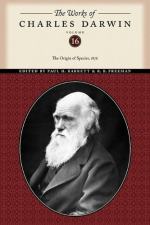
On the Origin of Species By Means of Natural Selection, or, the Preservation of Favoured Races in the Struggle for Life eBook

This eBook from the Gutenberg Project consists of approximately 532 pages of information about On the Origin of Species By Means of Natural Selection, or, the Preservation of Favoured Races in the Struggle for Life.

On the Origin of Species By Means of Natural Selection, or, the Preservation of Favoured Races in the Struggle for Life eBook

This eBook from the Gutenberg Project consists of approximately 532 pages of information about On the Origin of Species By Means of Natural Selection, or, the Preservation of Favoured Races in the Struggle for Life.
off from some very ancient Marsupial, which will have had a character in some degree intermediate with respect to all existing Marsupials; or that both Rodents and Marsupials branched off from a common progenitor, and that both groups have since undergone much modification in divergent directions.  On either view we may suppose that the bizcacha has retained, by inheritance, more of the character of its ancient progenitor than have other Rodents; and therefore it will not be specially related to any one existing Marsupial, but indirectly to all or nearly all Marsupials, from having partially retained the character of their common progenitor, or of an early member of the group.  On the other hand, of all Marsupials, as Mr. Waterhouse has remarked, the phascolomys resembles most nearly, not any one species, but the general order of Rodents.  In this case, however, it may be strongly suspected that the resemblance is only analogical, owing to the phascolomys having become adapted to habits like those of a Rodent.  The elder De Candolle has made nearly similar observations on the general nature of the affinities of distinct orders of plants.

On the principle of the multiplication and gradual divergence in character of the species descended from a common parent, together with their retention by inheritance of some characters in common, we can understand the excessively complex and radiating affinities by which all the members of the same family or higher group are connected together.  For the common parent of a whole family of species, now broken up by extinction into distinct groups and sub-groups, will have transmitted some of its characters, modified in various ways and degrees, to all; and the several species will consequently be related to each other by circuitous lines of affinity of various lengths (as may be seen in the diagram so often referred to), mounting up through many predecessors.  As it is difficult to show the blood-relationship between the numerous kindred of any ancient and noble family, even by the aid of a genealogical tree, and almost impossible to do this without this aid, we can understand the extraordinary difficulty which naturalists have experienced in describing, without the aid of a diagram, the various affinities which they perceive between the many living and extinct members of the same great natural class.

Extinction, as we have seen in the fourth chapter, has played an important part in defining and widening the intervals between the several groups in each class.  We may thus account even for the distinctness of whole classes from each other—­for instance, of birds from all other vertebrate animals—­by the belief that many ancient forms of life have been utterly lost, through which the early progenitors of birds were formerly connected with the early progenitors of the other vertebrate classes.  There has been less entire extinction of the forms of life which once connected fishes with batrachians.  There

Copyrights
Project Gutenberg
On the Origin of Species By Means of Natural Selection, or, the Preservation of Favoured Races in the Struggle for Life from Project Gutenberg. Public domain.

