
Forgot your password?  
Related Topics

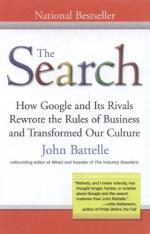
The Search | Quiz

This Study Guide consists of approximately 45 pages of chapter summaries, quotes, character analysis, themes, and more - everything you need to sharpen your knowledge of The Search.

The Search | Quiz

Students: Take our free The Search quiz below, with 25 multiple choice questions that help you test your knowledge. Determine which chapters, themes and styles you already know and what you need to study for your upcoming essay, midterm, or final exam. Take the free quiz now!

Teachers: The BookRags Lesson Plan contains hundreds of test and quiz questions, including multiple choice, short answer, and essay questions. Create your own quiz or test with our automatic test generator, or choose from our ready-to-go chapter quizzes, midterm tests, and final exams. Don’t waste time reinventing the wheel, get the Lesson Plan today!

Directions: Click on the correct answer.

1)

When is the first version of Google officially released? (from Chapter 4, Google Is Born)

March 1998.
February 1995.
April 1997.
August 1996.
2)

Which discovery leads Battelle to contemplate the Internet's role in life? (from Chapter 12, Epilogue)

The shortest written novel.
The oldest written story.
The longest written novel.
The oldest written poem.
3)

What business model does Battelle give Bill Gross credit for inventing? (from Chapter 5, A Billion Dollars, One Nickel at a Time)

The combination of a small profit on individual transactions with a large volume of transactions.
Using the Internet to generate the maximum number of sales from its users through personalized advertising.
Selling an item to make as much of a profit as possible, reducing the total number of sold products needed.
Requiring a small monthly membership fee for access to certain Internet features.
4)

What does Susan Wojcicki rent to Page and Brin for them to use to develop further technology? (from Chapter 4, Google Is Born)

A garage.
A computer lab.
An office building.
A room in her house.
5)

Why do advertisers like Gross' marketing system? (from Chapter 5, A Billion Dollars, One Nickel at a Time)

They are giving input to Gross on how to design it.
They are receiving discounts on their advertising to endorse GoTo.com.
They are wasting less money in advertising costs.
They see an increased level of traffic to their websites.
6)

What does Google add to the concept of parallel computing to make it even more beneficial? (from Chapter 6, Google 2000-2004: Zero to $3 Billion in Five Years)

The notion of allowing other companies access to their hardware to cut operating costs.
Huge, cost-effective scaling by using inexpensive hardware.
The plan to build all of their own hardware to reduce labor and equipment costs.
Twice as much hardware to double their results.
7)

What notion does Battelle use in his story? (from Chapter 12, Epilogue)

Greed.
Nobility.
Heroism.
Immortality.
8)

How does Battelle state the question needs to be formed to achieve the desired results? (from Chapter 12, Epilogue)

In the shortest way possible.
With as much detail as possible.
Just right.
In an average of five words.
9)

What public relations idea does Google try after brand marketing, making it the only company not to spend any money on marketing? (from Chapter 6, Google 2000-2004: Zero to $3 Billion in Five Years)

Doing a series of radio interviews across the country.
Offering a free gift to every one-thousandth site visitor.
Giving away a certain number of advertising spaces.
Working with the press to release stories.
10)

With which well-known director does Gross create IdeaLab, a company where his ideas can be put into action? (from Chapter 5, A Billion Dollars, One Nickel at a Time)

Oliver Stone.
Ron Howard.
Steven Spielberg.
George Lucas.
11)

Regulation requires that a company must report as if it were public when it has how many employees? (from Chapter 9, Google Goes Public)

Over 500.
Over 2,000.
Over 150.
Over 1,000.
12)

What is the first management style that Google uses? (from Chapter 6, Google 2000-2004: Zero to $3 Billion in Five Years)

A corporate hierarchy with a chain of command and a flattened organization.
One that allows the owners to talk directly with the employees.
A concept that gives each employee partial ownership of the company through stocks.
One that requires all employees to report to the CEO on a daily basis.
13)

Under Gross' plan, when does an advertiser pay? (from Chapter 5, A Billion Dollars, One Nickel at a Time)

Upfront, before the ad is included on the search engine's Web page.
Only when a customer clicks on an ad.
On a weekly basis.
After a certain number of Internet users have purchased their products.
14)

Under Google's approach to search, what comes before technology? (from Chapter 10, Google Today, Google Tomorrow)

Nothing.
Ads.
Profits.
Humans.
15)

What Palo Alto street does Google relocate to after outgrowing its current location in 1999? (from Chapter 4, Google Is Born)

Cherry Street.
Fifth Street.
Brookdale Avenue.
University Avenue.
16)

According to Battelle, what two entities are public companies held accountable to? (from Chapter 8, Search, Privacy, Government, and Evil)

Its leaders and shareholders.
Its competitors and shareholders.
Its customers and employees.
Its advertisers and customers.
17)

Yahoo has a philosophy that places what above technology? (from Chapter 10, Google Today, Google Tomorrow)

Humans.
Leadership.
Profits.
Vision.
18)

What does Battelle think is vital to effective advertising, either on the Internet or other forms of media? (from Chapter 7, The Search Economy)

A product that appeals to as many different demographics as possible.
Name recognition.
The potential customer's intent.
A rapid increase in users or viewers.
19)

What does the "semantic Web" idea entail? (from Chapter 11, Perfect Search)

Web pages are tagged with calculus-based strings of logic read by a machine.
Web pages are tagged with algebra-based strings of logic read by a machine.
Web pages are controlled by a central machine that interprets algorithms.
Web pages are controlled by multiple machines that interpret algorithms.
20)

Battelle's examples are based on what Internet function? (from Chapter 12, Epilogue)

Blogs.
Search.
Advertising.
Email.
21)

Why does Google stop doing traditional brand marketing? (from Chapter 6, Google 2000-2004: Zero to $3 Billion in Five Years)

Larry Page and Sergey Brin are not skilled at brand marketing and do not know how to do it effectively.
There is another company called Google that people are confusing it with.
It isn't effective since most people didn't know who Google was yet.
The marketing costs are taking up 50 percent of its revenue.
22)

What do Internet users fear Google is doing to invade their privacy? (from Chapter 8, Search, Privacy, Government, and Evil)

Reading their emails.
Editing their emails.
Forwarding their emails to a central database.
Selling content found in their emails.
23)

After much consideration, what core value does Google adopt as its motto in 2001? (from Chapter 6, Google 2000-2004: Zero to $3 Billion in Five Years)

The Alternative to Evil.
We're Not Evil.
Don't Be Evil.
Why Be Evil?
24)

Google's association with what country signals the potential for the company to compromise its values? (from Chapter 8, Search, Privacy, Government, and Evil)

France.
Russia.
China.
Germany.
25)

What happens when Page tries to sell Google to other Internet companies? (from Chapter 4, Google Is Born)

The companies are not interested.
The companies do not understand how to operate Google.
The companies do not offer enough money.
The companies attempt to use the information Page gives them to make their own websites better.
Copyrights
The Search from BookRags and Gale's For Students Series. ©2005-2006 Thomson Gale, a part of the Thomson Corporation. All rights reserved.
Follow Us on Facebook
Homework Help
