
 Print
Print Word
Word PDF
PDF|
This section contains 324 words (approx. 1 page at 400 words per page) |

|
Mule Bone Summary & Study Guide Description
Mule Bone Summary & Study Guide includes comprehensive information and analysis to help you understand the book. This study guide contains the following sections:
This detailed literature summary also contains Bibliography and a Free Quiz on Mule Bone by Zora Neale Hurston.
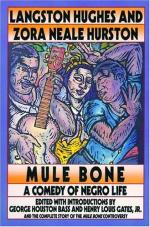
Mule Bone was written in 1930. It was a joint collaboration between noted African-American authors Zora Neale Hurston and Langston Hughes, who joined forces to write a play based on a folktale, "The Bone of Contention," that Hurston had discovered in her anthropological studies. Both writers conceived the play as representative of authentic black comedy. Shortly after the play's creation, however, Hurston copyrighted the play in her name only. The two authors had a falling out and did not speak to one another again. A legal battle ensued and, because of those legal issues, the play could not be produced during either writer's lifetime.
Mule Bone remained locked away. Few people read the play and it was largely forgotten until critic and historian Henry Louis Gates discovered the play in the early-1980s. Mule Bone was not performed on stage until 1991.
In many ways, Mule Bone has the ability to evoke both discussion and controversy. Hurston and Hughes felt that by incorporating a black folktale and southern black vernacular English into their play, they could refute a racist tradition of black characters as ignorant. However, when the play was finally developed for the stage more than sixty years later, there were concerns that this comedy might, instead, recall stereotypes and bring back the very issues that the authors had hoped to refute. It was thought that the play, as viewed by a audience in the 1990s, might appear to cast blacks as backward or ignorant. The director sought to mitigate that problem by including a section of Hurston's writings that explained her views on black vernacular English. Each writer brought separate talents to the writing of Mule Bone. Hughes was primarily a poet; Hurston was an essayist and novelist. Their quarrel ended what might have been a successful collaboration. As it stands today, Mule Bone is still considered a significant work of drama and is notable as an early work of African-American theatre.
Read more from the Study Guide
|
This section contains 324 words (approx. 1 page at 400 words per page) |
|




