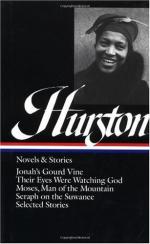
Zora Neale Hurston
Born January 7, 1891
Eatonville, Florida
Died January 28, 1960
Fort Pierce, Florida
American short story writer, autobiographer, novelist, and folklorist
One of the most memorable ...
Read more
Hurston, Zora Neale (1891-1960)
A prolific novelist, folklorist, anthropologist, and critic, Zora Neale Hurston was one of the inspiring personalities of the Harlem Renaissance. Her diverse interests ...
Read more
Zora Neale Hurston
Born January 7, 1891 (Eatonville, Florida)Died January 28, 1960 (Fort Pierce, Florida)
Author and folklorist
Zora Neale Hurston was a key figure in the Harlem Renaissance, one of th...
Read more
Biography EssayFrom the 1930s through the 1960s, Zora Neale Hurston was the most prolific and accomplished black woman writer in America. During that thirtyyear period she published seven books, many ...
Read more
Zora Neale Hurston (1903-1960), folklorist and novelist, was best known for her collection of African American folklore Mules and Men (1935) and her novel Their Eyes Were Watching God (1937), in whic...
Read more
"Zora was funny, irreverent (she was the first to call the Harlem Renaissance literati the 'niggerati'), good-looking and sexy," wrote Alice Walker. Having been one of the most prolific African-Americ...
Read more
From the 1930s through the 1960s, Zora Neale Hurston was the most prolific and accomplished black woman writer in America. During that thirty-year period she published seven books, numerous short st...
Read more
Zora Neale Hurston achieved moderate success during the Harlem Renaissance as a short-story writer and a collector of black-American folklore. Her stories deserve attention beyond the concerns of bla...
Read more
Critical Essay by Fannie Hurst
[Hurst, a popular novelist in the 1920s and 1930s, employed Hurston as a secretary-companion during Hurston's first years in New York City.]
Here in ["Jona...
Read more
Critical Essay by Otis Ferguson
It isn't that [Their Eyes Were Watching God] is bad, but that it deserves to be better. In execution it is too complex and wordily pretty, even dull—yet i...
Read more
Critical Essay by Sterling Brown
[The following essay was originally published in 1937.]
[Zora Neale Hurston's] short stories "Drenched With Light," "Spunk" and ...
Read more
Critical Essay by Carl Carmer
Folklore is a spontaneous product of vitality and imagination. It needs a careful interpreter whose reports have these same two qualities. Seldom has there been a happier...
Read more
Critical Essay by Percy Hutchison
["Moses: Man of the Mountain"] is the story of Moses as the Negro sees and interprets [him]…. None the less reverent in conception than that of t...
Read more
Critical Essay by Carl Carmer
The story of Moses has roots deep in the Hebraic imagination and Jews are proud to call it their own. Their minds have been especially busy with it in the last few years ...
Read more
Critical Essay by Philip Slomovitz
[It] is exceedingly interesting to read a new biography of the Hebrew prophet [Moses] written by an American Negro. Zora Neale Hurston has already acquired fame as a...
Read more
Critical Essay by Arna Bontemps
[Zora Neale Hurston's autobiography] "Dust Tracks on a Road" should not be read for its comments on the Negro as a whole. Miss Hurston feels that G...
Read more
Critical Essay by Beatrice Sherman
["Dust Tracks on a Road"] is a thumping story, though it has none of the horrid earmarks of the [Horatio] Alger-type climb. Zora Neale Hurston has a co...
Read more
Critical Essay by Worth Tuttle Hedden
Though "Seraph on the Suwanee" is the love story of a daughter of Florida Crackers and of a scion of plantation owners, it is no peasant-marries-the...
Read more
Critical Essay by Josephine Pinckney
["Jonah's Gourd Vine"] is the product of a fortunate combination of circumstances. [Hurston] writes as a Negro understanding her people and ha...
Read more
Critical Essay by Darwin T. Turner
A study of Zora Neale Hurston, writer, properly begins with Zora Neale Hurston, wanderer. In her autobiography, Dust Tracks on a Road—in her artful candor and...
Read more
Critical Essay by Addison Gayle, Jr.
Despite structural and formal defects, Jonah's Gourd Vine is most important for its depiction of the character of the black woman. Lucy is far from being co...
Read more
Critical Essay by Theresa R. Love
[Miss Hurston's goal in her nonfiction] was not merely to collect folklore but to show the beauty and wealth of genuine Negro material. In doing so, she placed...
Read more
Critical Essay by Robert E. Hemenway
Folklore, Hurston said, is the art people create before they find out there is such as thing as art; it come from a folk's "first wondering contact w...
Read more
Critical Essay by Alice Walker
A friend of mine … [told] me that she and another woman had been discussing Zora Neale Hurston and had decided they wouldn't have liked her. They wouldn...
Read more
Critical Essay by Lillie P. Howard
There is no indication that Zora N. Hurston was ever well known—as a writer or as a person—among the masses during her lifetime. With an impressive gro...
Read more
Critical Essay by Cheryl A. Wall
The critical perspectives inspired by the black consciousness and feminist movements allow us to see Hurston's writings in a new way. They correct distorted vie...
Read more
Critical Essay by Margaret Wallace
"Jonah's Gourd Vine" can be called without fear of exaggeration the most vital and original novel about the American Negro that has yet been wri...
Read more
Critical Essay by H. I. Brock
[Here, in "Mules and Men,"] is the high color of Color as a racial element in the American scene. And it comes neither from Catfish Row nor from a Harlem wi...
Read more
Critical Essay by Franz Boas
Ever since the time of Uncle Remus, Negro folk-lore has exerted a strong attraction upon the imagination of the American public. Negro tales, songs and sayings without end...
Read more
Critical Essay by Thomas Caldecot Chubb
[If] "Jonah's Gourd Vine" is a story with a background of sociology, "Mules and Men" is a social study with gusto of a story....
Read more
Critical Essay by The Times Literary Supplement
There is nothing in the title to indicate that ["Mules and Men"] is a picture of the negro mind revealed with commendable objectivity by a...
Read more
Critical Essay by Nick Aaron Ford
[This essay was originally published in 1936.]
[One] can readily see why Miss Hurston's first novel, Jonah's Gourd Vine, was received with small enthusi...
Read more
In the following excerpt, originally published in 1931, Hurston explains the view of African-American expression that informs her works, observing the drama, originality, and dialect of black communic...
Read more
In the following essay, Classon probes Color Struck as a work of social criticism and as the “tragedy of a darkskinned woman.” Additionally, Classon emphasizes the importance of this rel...
Read more
In the following essay, Carson discusses Hurston's early “Florida” plays: Color Struck, The First One, and The Fiery Chariot.
While a considerable amount of scholarly work exists ...
Read more
In the following essay, Lowe studies Hurston's dramatic works and the difficulties she experienced getting them into production.
Zora Neale Hurston has recently been rescued from literary obliv...
Read more
In the following essay, Speisman surveys Hurston's career as a dramatist and her influence on American theater.
On 12 April 1926, in a letter to Langston Hughes, Zora Neale Hurston asked Hughes...
Read more
In the following review, originally published in the New York Times on February 15, 1991, Rich enumerates several flaws in the Lincoln Center Theater production of Mule Bone, and observes that the pla...
Read more
In the following essay, Boyd offers an initial evaluation of Mule Bone, a plays she suggests requires further critical study. She examines the famous literary quarrel of its authors, Hurston and Langs...
Read more
In the following essay, Wall contends that Hurston's narrative strategy in Mules and Men allows her to represent the ways in which women are relegated to subordinate roles in African American c...
Read more
In the following essay, Chinn and Dunn assert that “The Gilded Six-Bits” underscores Hurston's artistry as a fiction writer, folklorist, and historian.
“The Gilded Six-Bits...
Read more
In the following essay, Andrews explores the tradition of verbal assertiveness amongst African American women through an analysis of Mules and Men.
Patterns of negotiating respect through verbal asser...
Read more
In the following essay, Harrison investigates the influence of anthropological concepts developed by Franz Boas and his contemporaries on the narrative strategy of Hurston and Mary Hunter Austin.
As t...
Read more
In the following essay, Lester examines the homoerotic aspects of “Story in Harlem Slang: Jelly's Tale.”
Erotica was never written by gay men. It couldn't have been. We wer...
Read more
In the following essay, Meisenhelder analyzes the narrative techniques that Hurston utilizes to explore racial and sexual issues in Mules and Men.
In an oft-quoted passage from her introduction to Mul...
Read more
In the following essay, Champion asserts that Hurston depicts strong women in her stories who “develop independence in spite of oppressive social conditions, particularly those influenced by a ...
Read more
In the following essay, Wainwright views Hurston's female storytellers in Mules and Men as a way to subvert conventional gender roles and male authority.
During the Great Depression, Zora Neale...
Read more
In the following essay, Seidel asserts that “Sweat” is valuable for its depiction of the economic situation in Eatonville, Florida, in the early decades of the twentieth century as well ...
Read more
In the following essay, Boxwell assesses Hurston's achievement as ethnographer in Mules and Men.
One of the most striking photographs ever taken of an African-American woman writer can be found...
Read more
In the following essay, Jones contends that “The Gilded Six-Bits” reflects elements of the pastoral and picaresque literary traditions.
The history of a people, recorded through folklore...
Read more
In the following essay, Jordan finds similarities between Mules and Men and J. Frank Dobie's Tongues of the Monte, maintaining that because of their unconventional formats, both books offer ...
Read more
In the following essay, Hale explores Hurston's allusion to Hamlet in her story “Spunk.”
Zora Neale Hurston's “Spunk” (1925) is a story of lust, killing, and ...
Read more
In the following essay, Hurd offers a thematic and stylistic analysis of “Sweat.”
Shortly after her 1925 arrival in New York City from Washington, D.C., and her native Eatonville, Florid...
Read more
In the following essay, Green contends that Hurston and Kate Chopin “both construct communities in which woman is equated with Other” in their respective stories “Sweat” an...
Read more
Zora Neale Hurston is a celebrated essayist, journalist, playwright, anthropologist and titan of twentieth century literature ("Zora" 8). She was born in Notasulga, Alabama on January 7,1891 (Andrews...
Read more
Feminism has been defined as the theory of the political, economic, and social equality of the sexes or organized activity on behalf on women's rights and interests (Webster's). Zora Neale Hurston, bo...
Read more