
 Print
Print Word
Word PDF
PDF|
This section contains 367 words (approx. 1 page at 400 words per page) |

|
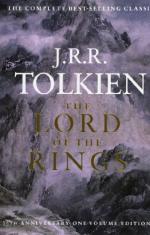
The Lord of the Rings Summary & Study Guide Description
The Lord of the Rings Summary & Study Guide includes comprehensive information and analysis to help you understand the book. This study guide contains the following sections:
This detailed literature summary also contains Bibliography and a Free Quiz on The Lord of the Rings by J. R. R. Tolkien.
In 1997, Lord of the Rings was voted, to the chagrin of some critics, the greatest book of the twentieth century in a poll run by major British booksellers. Despite some negative criticism, Lord of the Rings has been a steady best-seller since the first volume was published in 1954, and a campus craze in the sixties and early seventies. The extensive fantasy sections in today's bookstores, from Terry Brooks to Terry Pratchett, are all its children, as are, if George Lucas is to be believed, the Star Wars films.
On the surface, a combination of popular acclaim and critical disquiet is a baffling response to the work of an Oxford professor saturated in the study of language development and early medieval literature. Still, it is perhaps this crossing of characters and situations common to epic and folktale with a judicious use of novelistic technique that accounts for both its popularity with the reading public and the hostility of some critics, whose literary culture is too centered in the avant-garde to be comfortable with a work that reaches so deeply into medieval literature and which rejects, however thoughtfully, moral relativism. Despite its roots in medieval literature, Lord of the Rings places its characters and its readers on a collision course with modern moral dilemmas of knowledge and power. Tolkien poses these modern problems with absolute ethical principles and a belief in both an overarching providence and the importance of human choice. These ethical absolutes are, however, at least partially expressed in terms of a new type of hero, one which does not supplant the old epic hero but which complements it. Although Tolkien always insisted that Lord of the Rings was not allegorical, it is apparent that the Ruling Ring and the destruction of the natural world that flows from the desire for its power are a reflection of Tolkien's concern for humanity's ability to destroy both itself and the earth. That Tolkien chooses a course of total rejection of such knowledge and power is perhaps one of the unconscious sources of some critics' reaction to the work. Such a rejection strikes at the heart of the concept of progress as it has developed in western civilization.
Read more from the Study Guide
|
This section contains 367 words (approx. 1 page at 400 words per page) |
|




