
 Print
Print Word
Word PDF
PDF|
This section contains 268 words (approx. 1 page at 400 words per page) |

|
Look Homeward, Angel Summary & Study Guide Description
Look Homeward, Angel Summary & Study Guide includes comprehensive information and analysis to help you understand the book. This study guide contains the following sections:
This detailed literature summary also contains Bibliography and a Free Quiz on Look Homeward, Angel by Thomas Wolfe.
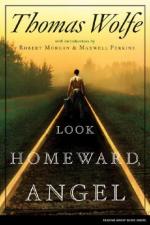
A thinly disguised autobiography and a portrait of the early twentieth-century American South, Look Homeward, Angel is the most famous book of an author who used to be regarded as an equal of Ernest Hemingway, F. Scott Fitzgerald, and William Faulkner. Published in New York in 1929, Thomas Wolfe's novel was considered striking and important—a work by a genius with a grand, compelling personality. It is a novel in the American romantic tradition, meant to contain Wolfe's own "American experience" as represented by his alter ego, Eugene Gant.
In the seventy-four years since it was published, the novel has received steadily less critical attention. Wolfe's initial editor, Maxwell Perkins, cut sixty thousand words from its original text to make it more readable, but many recent critics and readers continue to find Look Homeward, Angel a hugely sprawling text that is sometimes clearly bombastic. Some are also offended by what it says about race and gender. These elements have led to a decline in Wolfe's reputation and a reevaluation of his importance to the literary movement of his time.
Nevertheless, Wolfe's first novel remains very important to the twentieth-century American tradition, and Wolfe generally retains his contemporary reputation as a unique genius. The best critical approach to his work is one that understands it firmly within its time and place. It is a novel with a strong sense of autobiography, a Bildungsroman (novel of development), an attempt at a comprehensive display of life in the American South from 1900 to 1920, and a response to the modernist movement of American writers who were living and writing in Europe.
Read more from the Study Guide
|
This section contains 268 words (approx. 1 page at 400 words per page) |
|




