
 Print
Print Word
Word PDF
PDF|
This section contains 343 words (approx. 1 page at 400 words per page) |

|
Jasmine Summary & Study Guide Description
Jasmine Summary & Study Guide includes comprehensive information and analysis to help you understand the book. This study guide contains the following sections:
This detailed literature summary also contains Bibliography and a Free Quiz on Jasmine by Bharati Mukherjee.
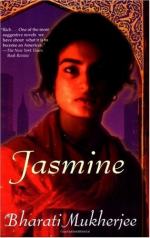
Bharati Mukherjee's Jasmine, the story of a widowed Punjabi peasant reinventing herself in America, entered the literary landscape in 1989, the same year as Salmon Rushdie's Satanic Verses. Rushdie, also an Indian writer, received international attention for his novel when a fatwa (or death threat) was issued against him. The fatwa essentially proclaimed it a righteous act for any Muslim to murder Rushdie. Michelle Cliff's No Telephone to Heaven, Jill Ker Conway's The Road to Coorain, Tsitsi Dangarembga's Nervous Condition, Jamaica Kincaid's A Small Place, and Amitav Ghosh's The Shadow Lines were all published around this time. Each of these writers is considered to be a contributor to the genre of postcolonial literature. Although there is considerable debate over the term "postcolonial," in a very general sense, it is the time following the establishment of independence in a (former) colony, such as India. The sheer extent and duration of the European empire and its disintegration after the Second World War have led to widespread interest in postcolonial literature.
Partly because of the abundance of such postcolonial works, some critics suggested Jasmine was part of a fad. The New York Times Book Review, however, named it one of the year's best works.
Mukherjee's time as a student at the University of Iowa's acclaimed Masters of Fine Arts program, the Writer's Workshop, almost certainly informed the setting of Jasmine. She began studies there in 1961 and took her MFA in 1963. She stayed on to earn a Ph.D. in English and comparative literature in 1969. Though Iowa City is a small college town, the state is 95 percent farm land. In the 1980s, when Jasmine is set, many family farmers on the outskirts of Iowa City faced the same dilemma as Darrel Lutz, a character in Jasmine. The hard life of farming coupled with tough times economically persuaded many farmers to sell out to large corporate farms or to non-agricultural corporations. Other farmers struggled on determined to save the farm their fathers and grandfathers had built up, as well as to preserve this unique way of life.
Read more from the Study Guide
|
This section contains 343 words (approx. 1 page at 400 words per page) |
|




