
 Print
Print Word
Word PDF
PDF|
This section contains 710 words (approx. 2 pages at 400 words per page) |

|
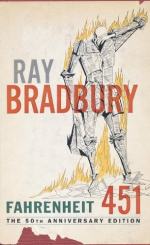
Fahrenheit 451 Summary & Study Guide Description
Fahrenheit 451 Summary & Study Guide includes comprehensive information and analysis to help you understand the book. This study guide contains the following sections:
This detailed literature summary also contains Topics for Discussion and a Free Quiz on Fahrenheit 451 by Ray Bradbury.
This prophetic novel, first written and published in the early 1950s, is set in a future where books, and the ideas they represent and manifest, are burned to prevent disruptions in society. Its central character, Guy Montag, is a fireman responsible to that society for ensuring those burnings takes place, but an unexpected chain of events leads him to question both himself and the society in which he lives. Through its intense, action-packed telling of Montag's story, the narrative explores themes relating to the need for and power of independent thought, humanity's capacity for self-limitation, and the value of courage.
The novel begins with a graphic description of the pleasure and satisfaction experienced by Montag as he burns a house and the collection of books it once concealed. Later, as he walks home, he encounters a beautiful young woman who disturbs him with probing questions about happiness. Over the next week, Montag has regular encounters her, causing him to question who he is and what he does. At the end of that week, he is disturbed to discover that the woman, along with the rest of her family, has disappeared.
Montag's disquiet increases when he participates in a burning at the home of an elderly woman who, much to the surprise of Montag and his fellow firemen, watches calmly as they douse her home and precious books with kerosene and then lights a match, setting herself on fire as well. During the confusion of this burning, Montag conceals a book under his coat, later concealing it at home as well.
After a troubled night's sleep that results in him absenting himself from work, Montag is visited by his captain who, while reminding him that books are dangerous, implies that any fireman who finds himself curious about what books are actually like can have one for as long as twenty four hours, but it must eventually be burned. Meanwhile, Montag's wife discovers the concealed book, which narration reveals is a Bible. Montag later confesses that he has a concealed collection of books, eventually convincing his wife (who is worried that their home will be destroyed if anyone finds out what they've got) to read with him. She is unable, or unwilling, to get any meaning out of the books, eventually returning her attention to the house's expensive, addictive entertainment system. Meanwhile, Montag desperately memorizes verses from the Bible and also makes contact with a man with whom he had once had an unguarded conversation about books, the elderly Professor Faber. Together, the two men begin to plan a subversive attack on the book-burning system.
When he gets home after his conversation with Faber, Montag discovers that his wife has invited friends to join her for an evening of entertainment. Montag's frustration with the superficiality and violence of that entertainment leads him to confront his wife and her friends with a reading of poetry. This causes upset in the friends, who both leave. At the firehall that night, a potential argument over the value of books and the thoughts they contain (an argument which Beatty fuels with strings of literary quotes) is interrupted by an alarm which, Montag is dismayed to learn, has been called in by his wife. After she flees the scene (and her marriage), and after being forced to torch his own home, Montag's anger, frustration and fear lead him to turn his flamethrower onto his captain, who is incinerated. Montag then flees himself, making his way to Professor Faber's, where the two men plot his escape.
Pursued by authorities desperate to demonstrate that his crime of independent thinking cannot and will not go unpunished, Montag flees to the countryside, where he eventually evades capture and finds himself drawn into a group of learned men, themselves escapees from society and each of who carries, in his memory, the text of an important piece of writing. As the men compare notes and dream of the future, the city from which Montag just escaped is destroyed by airborne bombers, fighting a war that has been looming over the action throughout the narrative. As he watches the dust settle from the bombing raid, Montag recalls the Bible verses he memorized and vows to one day live by them.
Read more from the Study Guide
|
This section contains 710 words (approx. 2 pages at 400 words per page) |
|




