
 Print
Print Word
Word PDF
PDF|
This section contains 214 words (approx. 1 page at 400 words per page) |

|
The Barber of Seville Summary & Study Guide Description
The Barber of Seville Summary & Study Guide includes comprehensive information and analysis to help you understand the book. This study guide contains the following sections:
This detailed literature summary also contains Bibliography and a Free Quiz on The Barber of Seville by Pierre Beaumarchais.
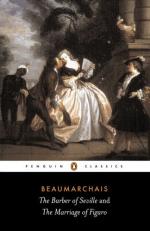
The Barber of Seville was Pierre-Augustin Caron de Beaumarchais's first comic work and first successful play. Beaumarchais drew on age-old themes and comic types to create a work that dazzled the audience with its humorous wordplay, irreverent activity, and lively characterization. The use of archetypal characters allowed viewers to readily relate to Figaro and company. However, Beaumarchais imbues his characters with traits of particular importance to his original pre-Revolutionary audience. Thus does The Barber of Seville successfully take on weightier issues than do most comedies.
Figaro easily emerges as the star of The Barber of Seville. So popular was he that Beaumarchais brought Figaro back a few years later in The Marriage of Figaro. In addition, the radical cry that Beaumarchais raises, the condemnation of the prevailing social system, is most apparent through Figaro. As Geoffrey Brereton points out in French Comic Drama from the Sixteenth to the Eighteenth Century, "Figaro's self-confidence, rooted in the conviction that inherently he is as good as any other man, is the basis of the social criticism already apparent, though muted, in this play." Figaro also is a successful character because of his joyful yet irrepressible behavior. He survives in contemporary times as the epitome of the roguish figure, endowed with cleverness, wit, and restrained insolence.
Read more from the Study Guide
|
This section contains 214 words (approx. 1 page at 400 words per page) |
|




