BookRags.com Literature Guides Literature Guides Criticism/Essays Criticism/Essays Biographies Biographies My Bibliography Periodic Table U.S. Presidents Shakespeare Sonnet Shake-Up
Research Anything:        
History | Encyclopedias | Films | News | Create a Bibliography | More... Login | Register | Help

Search "Chromosome"

Contents Navigation


Chromosome

Print-Friendly  Order the PDF version  Order the RTF version
About 3 pages (749 words)
Chromosome Summary

Bookmark and Share

Chromosome

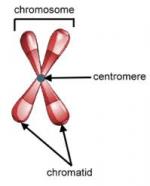
A chromosome consists of the body's genetic material, the deoxyribonucleic acid, or DNA, along with many kinds of protein. Chromosomes contain the genes, or segments of DNA, that encode for proteins of an individual. When a chromosome is structurally faulty, or if a cell contains an abnormal number of chromosomes, the types and amounts of the proteins encoded by the genes are altered. Changes to proteins often result in serious mental and physical defects and disease.

Within the chromosomes, the DNA is tightly coiled around these proteins (called histones) allowing huge DNA molecules to occupy a small space within the nucleus of the cell. When a cell is not dividing, the chromosomes are invisible within the cell's nucleus. Just prior to cell division, the chromosomes uncoil and begin to replicate. As they uncoil, the individual chromosomes take on a distinctive appearance that allows physicians and scientists to classify the chromosomes by size and shape.

Humans have 22 pairs of autosomal chromosomes and one pair of sex chromosomes, for a total of 46 chromosomes. These chromosomes can be studied by constructing a karyotype, or organized depiction, of the chromosomes.

In most animals, two types of cell division exist. In mitosis, cells divide to produce two identical daughter cells. Each daughter cell has exactly the same number of chromosomes. This preservation of chromosome number is accomplished through the replication of the entire set of chromosomes just prior to mitosis.

Sex cells, such as eggs and sperm, undergo a different type of cell division called meiosis. Because sex cells each contribute half of a zygote's genetic material, sex cells must carry only half the full complement of chromosomes. Meiosis produces four daughter cells, each with half of the normal number of chromosomes. These sex cells are called haploid cells (haploid means half the number). Non-sex cells in humans are called diploid (meaning double the number) since they contain the full number of normal chromosomes.

Chromosome abnormalities describe alterations in the normal number or structure of chromosomes. Deviations in the number of chromosomes generally occur as a result of the fusion of sex cells (gametes) with the incorrect number of chromosomes during the process of fertilization. Organisms with structurally altered chromosomes are general the result of a fusion of a sperm cell (spermatocyte) or egg cell (öocyte) that contains a structurally altered chromosome with a normal egg or sperm during conception. In addition, some chromosome abnormalities may occur shortly after conception. In this case, the zygote, the cell formed during conception that develops into an embryo, divides incorrectly.

Because chromosomal alterations in structure cause the loss or misplacement of genes, the effects of these defects can be quite severe. Deletions are usually fatal to a zygote. Duplications, inversions, and translocations can cause serious defects, as the expression of the gene changes due to its changed position on the chromosomes.

Two kinds of chromosome number defects can occur in humans: aneuploidy, an abnormal number of chromosomes, and polyploidy, more than two complete sets of chromosomes. Most alterations in chromosome number occur during meiosis. During normal meiosis, chromosomes are distributed evenly among the four daughter cells. Sometimes, however, an uneven number of chromosomes are distributed to the daughter cells.

When an egg or sperm that has undergone faulty meiosis and has an abnormal number of chromosomes unites with a normal egg or sperm during conception, the zygote formed will have an abnormal number of chromosomes. This condition is called aneuploidy. There are several types of aneuploidy. If the zygote has an extra chromosome, the condition is called trisomy. If the zygote is missing a chromosome, the condition is called monosomy.

Polyploidy is lethal in humans. Normally, humans have two complete sets of chromosomes. Normal human cells, other than sex cells, are termed diploid cells. In polyploidy, a zygote receives more than two complete chromosome sets. Examples of polyploidy include triploidy, in which a zygote has three sets of chromosomes, and tetraploidy, in which a zygote has four sets of chromosomes. Triploidy could result from the fertilization of an abnormal diploid sex cell with a normal sex cell. Tetraploidy could result from the failure of the zygote to divide after it replicates its chromosomes. Human zygotes with either of these conditions usually die before birth, or soon after. Interestingly, polyploidy is common in plants and is essential for the proper development of certain stages of the plant life cycle. In addition, some kinds of cancerous cells exhibit polyploidy. Rather than die, the polyploid cells have the abnormally accelerated cell division and growth characteristic of cancer.

This is the complete article, containing 749 words (approx. 2 pages at 300 words per page).

More Information
  • View Chromosome Study Pack
  • Search Results for "Chromosome"
  • Add This to Your Bibliography
  • More Products on This Subject
    Heinrich Wilhelm Gottfried von Waldeyer-Hartz
    Heinrich Wilhelm Gottfried von Waldeyer-Hartz was a professor of anatomy and histology who coined t... more

    Heinrich Wilhelm Gottfried von Waldeyer-Hartz
    Heinrich Wilhelm Gottfried von Waldeyer-Hartz was a professor of anatomy and histology who coined t... more


    Copyrights
    Chromosome from World of Genetics. ©2005-2006 Thomson Gale, a part of the Thomson Corporation. All rights reserved.

    Join BookRagslearn moreJoin BookRags


    About BookRags | Customer Service | Report an Error | Terms of Use | Privacy Policy